The last piece on this page ended with three words from a stranger: Know your farmer. The shortest road to knowing your farmer is to be one, and the shortest road to being one runs through three hens in the backyard. So here is the part the egg video never got to: what the big Texas cities actually allow, the small European town that handed out chickens like library cards and watched its garbage trucks come back light, what to do if all you have is a patio, and the one thing a hen can teach a bird dog that no trainer can.
— SAMUEL BUTLER, LIFE AND HABIT, 1877
· · ·
“How often would I have gathered thy children together, even as a hen gathereth her chickens under her wings.”
— MATTHEW 23:37
What Texas cities let you keep
Houston has no zoning and never has, and its chicken rule reads like it: up to thirty fowl on a standard lot, no permit, no rooster, and the coop a hundred feet from any house, church, school, or hospital that is not yours.1 That hundred feet is the catch. On a sixty-five-foot lot inside the Loop it is arithmetic you cannot win, and out past Katy it is nothing. Dallas has no simple cap; the pen must sit twenty feet off the neighbor’s property line, and since September 2023 a rooster is legal in Dallas for the first time in living memory, which a few thousand Dallas neighbors are still finding out at five in the morning.1 Fort Worth counts by the acre: twelve fowl on a half-acre or less, twenty-five up to an acre, fifty above it, two roosters, coop fifty feet from the next fellow’s house.1 San Antonio allows eight without a permit, one of them a rooster, fifty feet from the neighbor. Austin, being Austin, sets no number at all; the enclosure for two or more birds has to be thirty feet from the next residence, down from fifty, and the coop needs four sides and a roof and the hens cannot run the street.1
Under all of that sits a state law. In 2023 the Legislature passed House Bill 1750 and the voters wrote a right to farm into the Texas Constitution that November; a city may still set the count and the distances, but it may no longer decide that a coop is a nuisance on its face.2 What the law did not touch is the homeowners association. A deed restriction can still say no chickens, and the bills to rein that in died in Austin in 2025.2 So the order of operations is: read your deed, then read your city, then buy the birds.
The Belgians and the garbage truck
In 2010 the province of Limburg in Belgium tried something no American city has had the nerve to try. It offered every household that wanted them three laying hens, free, on one condition: keep them at least two years, no giving them away, no Sunday dinner. About two thousand families took the deal. Six thousand hens went into two thousand backyards, and they did what hens do with potato peels, bread heels, wilted lettuce, and last night’s rice. In the first month the province’s food waste headed for the landfill dropped by somewhere between forty-five and a hundred tons, depending on which account you read, and the town of Mouscron ran its own version that same year, with a Brussels district named Etterbeek following in 2015.3 Nobody has run a peer-reviewed study on it, and I will say so plainly, because the people who ran the trucks did not need one. A hen eats what a family throws away, turns it into an egg by morning, and the garbage man lifts a lighter can. That is the whole economy of the thing, and it worked in a country that pays its garbage men well enough to notice.
Do the Texas arithmetic. Anybody who has carried a Houston garbage can to the curb knows what is heavy in it, and it is not the junk mail. Three hens per willing household would not empty a landfill, but the Belgians proved they would take a bite out of it in thirty days, at a cost of three birds and a feed sack. No city council in Texas has ever put it on an agenda. The cities are busy measuring a hundred feet from your neighbor’s kitchen window.
Quail, for the folks with a patio
If the setback rule beats you, or the HOA does, look at the Coturnix quail. A hen quail starts laying at six to eight weeks old, which is faster than any chicken alive, and lays two to three hundred eggs a year in a cage that needs a square foot per bird.4 She is quiet. She does not crow, does not scream when she lays, and does not need a run; a rabbit hutch on a back porch holds a dozen. A Coturnix hen is the only tenant in Texas who pays her rent in eggs and never once complains about the neighbors. Coturnix are a Japanese bird, not a Texas native, so Texas Parks and Wildlife does not require a game-bird license for them the way it does for a bobwhite.4 Most city chicken ordinances were written by people who had never heard of a quail and do not mention one, which is not the same as permission, so call the animal-control office and ask; a surprising number will tell you quail are not their department.4 By my own rough count four quail eggs run about one chicken egg, and the yolk on a quail egg from a bird fed greens and bugs comes out the same deep orange the last piece was about.
What a hen teaches a bird dog
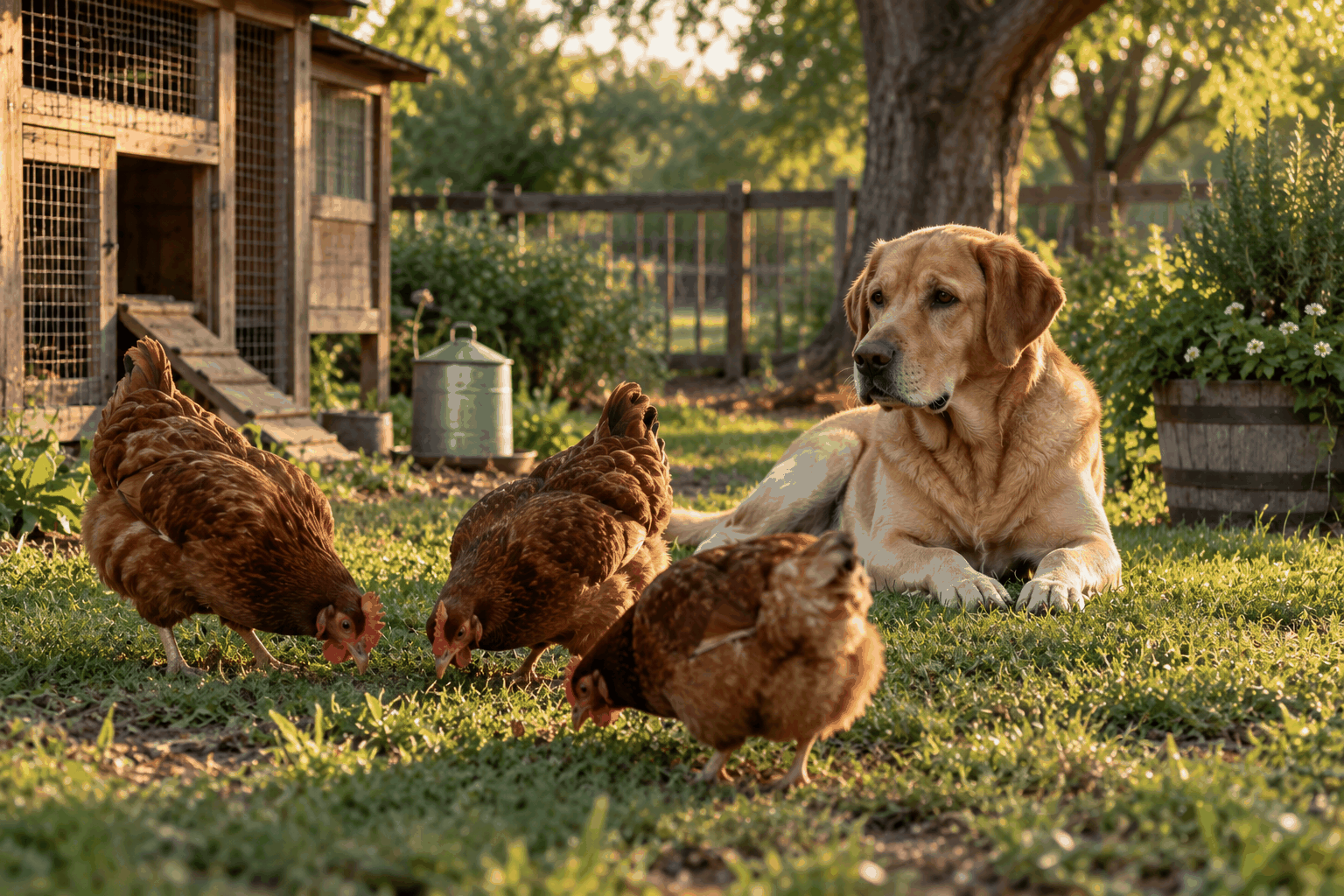
Now the part this page exists for. A Labrador bred to pick up ducks is bred to want a bird in his mouth more than he wants his supper. Put three hens in the yard with that dog and you have either a dead hen by Thursday or the best steadiness lesson money cannot buy, and which one you get is decided the first ten minutes. The rule on this place is simple. The dog is on a lead the first time he sees the birds. He may look. He may not move. The instant his weight shifts toward a hen he hears his name and feels the lead, and he sits, and he looks at the hen some more, and nothing happens. Ten minutes a day for a week. By the second week he lies in the shade with his chin on his paws and watches three hens walk across his water bowl, and that dog is worth more in a duck blind than one who has never been tempted, because a dog that will hold with a live hen at five feet will hold with a dead mallard at forty yards. The hen taught him what no training bird ever could: the bird is not his until he is sent.
The children learn the same lesson from the other end. A hen has to be fed before school and shut in before dark, and the eggs have to be gathered or a snake will do it for you, and no phone ever laid an egg. A child who has carried a warm egg in from the coop in the rain knows something about where breakfast comes from that no grocery store aisle will ever teach him, and a child who has watched a hawk take a hen knows something about the world. Three hens, one dog, and a couple of kids in a backyard is a farm, however small the yard, and it is the cheapest education in Texas.
A Lab watched three hens on the lawn
From dusk till the first light of dawn;
He never once stirred,
Though he wanted a bird —
“Not till I’m sent,” and he’d yawn.
— original, Hunters Creek
(Billy at the coop door with an egg in each fist, the Lab behind him with a hen’s tail feather stuck to his nose: “He didn’t eat her, Mommy. He just SMELLED her.”)
Read the deed first, the city second. Houston gives you thirty birds and a hundred feet you probably do not have; Fort Worth gives you twelve on a half-acre; Austin and Dallas give you distance rules and no count. If the yard is too small, a dozen Coturnix quail on a porch will out-lay a hen and never make a sound. Put the dog on a lead the first day, let him look and not move, and in two weeks you will have a steadier duck dog than any training bird ever made. Feed the hens what the family would have thrown away; the Belgians proved the garbage man will notice.
Keep reading: Orange Yolks, Bubbles, and the $500,000 Scale · Glyphosate Steals the Minerals: The Claw in Your Dog’s Bowl · Ninety Centuries of Real Milk
A note from John: I am a dog breeder and trainer, not a lawyer, and city ordinances change; the numbers above were checked in September 2026 against the sources below, and your city clerk has the current page. Deed restrictions override all of it. The dog method is mine, it has worked on this place for thirty-five years, and a dog with a hard prey drive and no lead will kill a hen before you finish reading this sentence, so use the lead.
Sources
[1] City ordinance summary (checked September 2026): Houston Code of Ordinances ch. 6, art. II (secs. 6-31, 6-35, 6-38); Dallas City Code ch. 7; Fort Worth City Code sec. 11A-22; San Antonio City Code ch. 5; Austin City Code sec. 3-2-13. Compiled at flockguide.com, “Raising Chickens in Texas”; Austin details also KUT, June 13, 2024.
[2] Texas HB 1750 (88th Legislature, 2023), amending the Right to Farm Act, Agriculture Code ch. 251; Texas Proposition 1 (Nov. 2023), constitutional right to farm, ranch, and raise livestock; KUT, June 13, 2024; 2025 bills to limit HOA chicken bans (HB 2013, SB 141) did not pass.
[3] Adventure.com, “How can we cut down on food waste? Belgium has a clucking good idea” — Limburg/Diest backyard-hen program; Mouscron (2010) and Etterbeek (2015) programs. The article notes no peer-reviewed measurement exists. Green Technology Investments reports the same Limburg program and more than 45,000 kg of food waste kept out of landfills in the first month.
[4] Delve Experiences, “Thinking About Raising Quail? What to Know Before You Start” (Texas guide) — Coturnix hens lay at 6–8 weeks, roughly 200–300 eggs per year, about one square foot per bird; Coturnix require no Texas game-bird breeder license, while native bobwhite do; verify local ordinances with animal services.