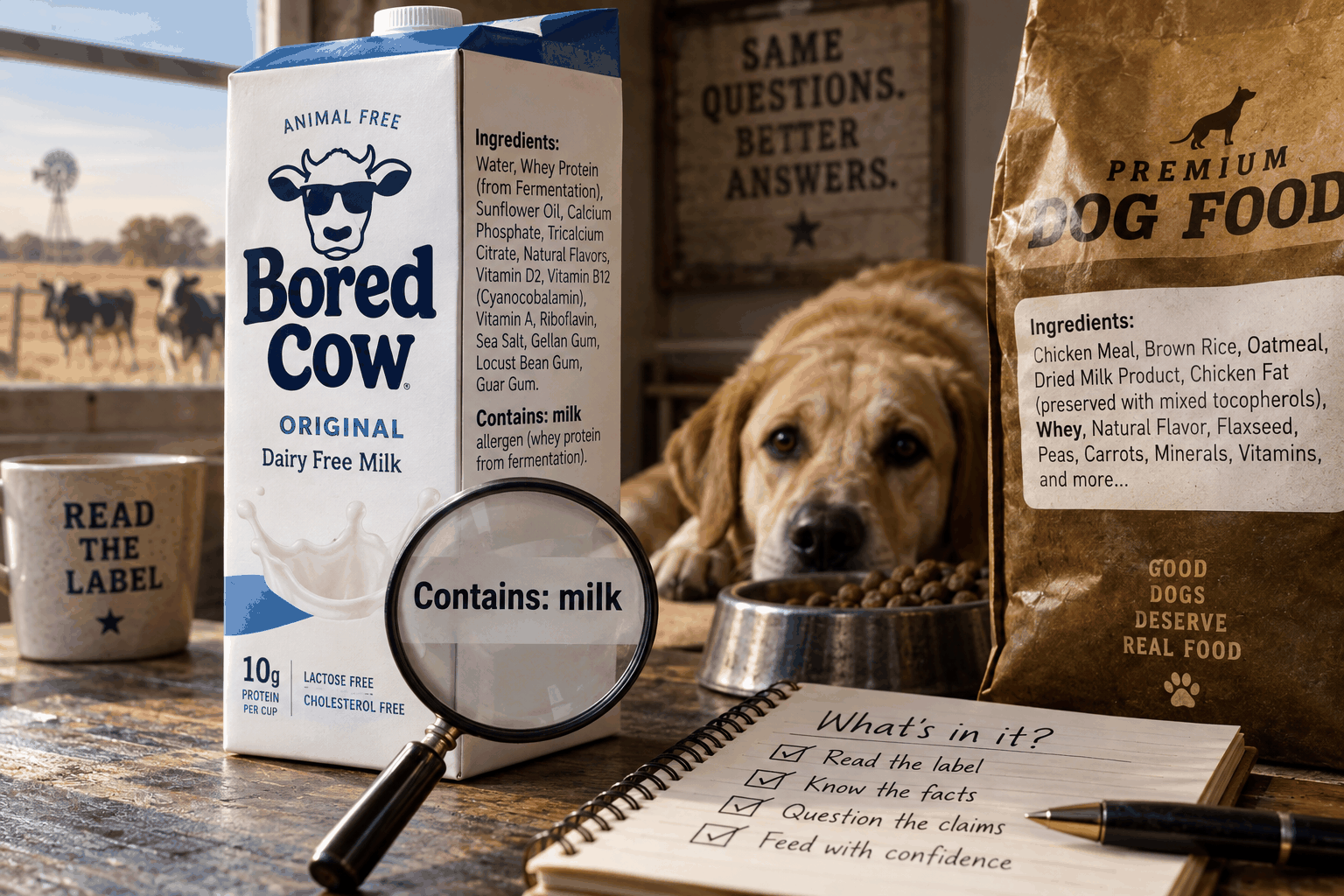
A thousand words went up about lab-created dairy sneaking into the food supply. Hundreds of people piled into the comments to be afraid together. Nobody in the entire thread appears to have picked up a carton and turned it around.
— DANIEL PATRICK MOYNIHAN
· · ·
“He that answereth a matter before he heareth it, it is folly and shame unto him.”
— PROVERBS 18:13
The account is thefarmacyreal. The subject is precision fermentation — whey protein grown by a fungus in a steel tank instead of squeezed out of a cow, sold to food companies by an outfit in Berkeley called Perfect Day, already sitting in products on American shelves.1 The comment section runs the whole circuit inside about forty replies: carbon math, allergy panic, nutritional collapse, “Disable the FDA,” “Goyslop,” and one fellow citing a 2026 study in Scientific Reports about rogue metabolites in the stuff.
Underneath all of it is one question, and it is a completely reasonable question for a grown man or woman to ask: how am I supposed to know if this is in my food?
The answer was printed on the box before the post was written. It is in bold. Federal law put it there in 2004.
The lab-grown dairy label the law already wrote — section 403(w)
Milk is one of the nine major food allergens named in federal law. Under section 403(w) of the Federal Food, Drug, and Cosmetic Act — 21 U.S.C. 343(w), added by the Food Allergen Labeling and Consumer Protection Act of 2004 — any food that is or contains a major food allergen must declare it, plainly, in English, either inside the ingredient list or in a “Contains” statement right beneath it.2
Now here is the part that ends the argument. The FDA did not leave this to be worked out later by lawyers. It wrote the answer into the letter it sent Perfect Day, in 2020, in a sentence anybody can read:
“β-lactoglobulin produced by fermentation requires labeling under the FD&C Act because it contains protein derived from milk.”3
Six years ago. In writing. Signed by a division director with her name on it.
Go look at what is actually on shelf. The ingredient line on Bored Cow, the best-known consumer product built on this protein, reads: “Water, Whey Protein (from Fermentation), Sunflower Oil, Sugar…” — and the allergen statement underneath says “Contains: milk allergen (whey protein from fermentation).”4
Whey protein from fermentation. Contains milk. It could not announce itself more loudly if it came with a marching band.
The label is written by the man who wants your money; the ingredient list is written by the law.
The front of the box is advertising — animal-free, farm-free, kind, clean, whatever word tested best with a focus group in a room that never sent you an invitation. The back of the box is a legal instrument. One is a man talking. The other is a man under oath.
Every wave of fear about the food supply gets sold on the premise that they are hiding it. On this one, they are not, because on this one they are not allowed. A woman who wants no lab-made whey in her kitchen has to do exactly one thing: turn the box around, the way her grandmother turned a melon over before she bought it.
A thousand words of dread over a question the ingredient list answers in four.
Who Perfect Day is, and what “FDA approved” is not
The company is Perfect Day, Inc., of Berkeley, California, which tells you a fair amount before we begin. The organism is Trichoderma reesei, a soil fungus that industry has used for decades to churn out enzymes. The gene for bovine beta-lactoglobulin — the main whey protein in cow’s milk — is put into the fungus, the fungus is fed sugar in a tank and secretes the protein, and the protein is filtered out and dried into powder. That is the whole trick. No cow, no pasture, no barn, no manure, no vet bill, no two-in-the-morning calving.
The regulatory paperwork is GRAS Notice 863, filed with the agency on 28 June 2019 and closed on 25 March 2020, with the FDA responding that it had “no questions.”3 Since then the same door has opened for Remilk out of Israel (GRN 1056, February 2023), Imagindairy (GRN 1145, December 2023), and Onego Bio’s fermented egg white (GRN 1249, September 2025). Germany’s Formo has a casein notice filed and still pending, and went to market on self-affirmed GRAS while it waits.5
Now correct the phrase everybody uses, including the companies. None of that is FDA approval. A GRAS no-questions letter is the agency declining to object to a determination the company itself made about its own product. FDA says so in its own letter: it “is not an affirmation that β-lactoglobulin is GRAS.”3 The agency also declined to bless a common or usual name for the ingredient, kicking that to a different office — which means there is no federally settled name for the thing on the ingredient line.3
That is a legitimate complaint, and it belongs to the skeptics fair and square. Self-affirmed GRAS is a genuine hole in American food law, big enough to drive a tank truck through, and Formo walking through it while its notice sat pending is the live example. A man can be entirely right about the loophole and entirely wrong about the label, and most of that comment section managed both at once.
The 2026 study: it exists, and here is what it says
One commenter cited a 2026 paper in Scientific Reports about rogue metabolites in synbio milk. The reflex in a piece like this is to say the study is imaginary and move on.
The study is real. Checking took twenty minutes, and anybody writing about this who says otherwise is going to get handed the DOI in public.
Velamuri, Yertha and Fagan, Scientific Reports 2026, volume 16, article 16029, published the third of April, 2026, out of Maharishi International University in Fairfield, Iowa. Title, in part: multi-omics profiling finds synbio milk differs nutritionally from bovine milk and contains 93 uncharacterized fungal metabolites and 236 fungal proteins.6
The findings, from the abstract itself. Synbio milk was reported deficient nutritionally against bovine milk. By three independent methods — shotgun proteomics, ELISA and classical protein analysis, and simulated mixing experiments — the material was found to be predominantly fungal protein rather than the ninety to ninety-nine percent beta-lactoglobulin the developer claims, with fungal protein content of 75.1, 86.5, and 90 to 95 percent respectively. Two hundred thirty-six T. reesei proteins were identified, mostly cellulases, hemicellulases, proteases and lipases. Ninety-three low-molecular-weight compounds were found present in synbio milk and absent from cow’s milk. Roughly seven of sixty-nine nutrients identified in bovine milk turned up in the synbio product, and the amino-acid composition deviated forty-one to forty-five percent from conventional, organic and biodynamic milk.6
That is a real paper reporting real numbers, and it has neither been refuted nor answered.
Where “92 compounds” actually came from
Track the number and the whole thing gets clearer, because the number is older than the paper. On the twenty-ninth of November, 2023, The Organic & Non-GMO Report ran a piece headlined “Not so precise fermentation: Lab finds 92 unknown compounds in synthetic biology milk.” The source was John Fagan, chief science officer at Health Research Institute Laboratories, reporting that his lab had tested a Bored Cow product and found ninety-two small molecules unknown to science. His quote: they are “completely novel to our food. They are things that we haven’t consumed as human beings.” Nothing was peer-reviewed at that time and no scientific meeting is named in the article. It traveled by trade press, podcasts and advocacy outlets for better than two years.7
On the eighteenth of April, 2025, the Organic Consumers Association and Toxin Free USA sued Perfect Day in D.C. Superior Court, alleging deceptive marketing and citing testing that found 86.6 percent fungal protein against the company’s stated ceiling of 6.7 percent fungal residue. The case is pending.8
On the third of April, 2026, the peer-reviewed paper landed, with the count at ninety-three. Same laboratory. Same senior author. Trade press, then a lawsuit, then a journal. Nothing about that sequence is illegal or even unusual, and it is exactly the sort of thing a reader is entitled to know before deciding how much weight to put on a number.
John Fagan is co-founder and chief scientist of Health Research Institute Laboratories and one of the most prominent anti-GMO scientists in this country, with a public record of opposing agricultural biotechnology going back decades. His institution is affiliated with the Maharishi organic and Vedic agriculture movement. The data underpinning an active consumer-protection lawsuit against Perfect Day came out of his lab.6,7,8
None of that makes a measurement false. A man with a position can still run a mass spectrometer correctly, and the people sneering at Fagan’s politics have not produced a single number of their own. What it means is that this is advocacy science — funded, framed and timed by people who wanted a particular answer — and advocacy science gets read the same careful way whether it comes from an organic institute in Iowa or a dairy conglomerate in New Zealand. Both appear in this blog. Both get the same treatment.
Then the limits, which the authors state themselves. No toxicological testing was performed. No allergenicity testing was performed. Safety verification was outside the paper’s scope. Shotgun proteomics does not see an entire proteome. The sample was one commercial product across two lots.6
One more thing, and it is the piece the internet keeps getting backwards. “Uncharacterized” means not matched to a reference database. It does not mean novel to nature, untested, dangerous, or rogue. Run untargeted metabolomics on any complex food and unassigned peaks come back by the fistful — on cow’s milk, on a strawberry, on the coffee at your elbow right now. Whether ninety-three is a scandalous number depends entirely on how many unassigned features the real milk threw, and that comparison is not in the abstract.
The word “rogue” is not the paper’s. The commenter added it. Somebody always adds it.
The allergy question, answered straight
Two claims went around that thread. One held these products are dangerous to the milk-allergic and unlabeled. The other held they are chemically identical to milk in every respect and nobody should worry about anything.
Both are wrong, and the true answer is short.
A milk-allergic person should treat this exactly as milk. FDA wrote it flat, in a letter signed by Susan Carlson, PhD, Director of the Division of Food Ingredients: β-lactoglobulin produced by fermentation “is identical to the protein found in bovine milk, it will produce a milk protein allergy when consumed by individuals with milk allergies.” The same letter adds that apart from the milk-allergic, beta-lactoglobulin is not known to produce adverse effects.3 The company said the same thing in its own submission, and the box says it too.
It is not, however, a perfect copy. The amino-acid sequence matches. The molecule as delivered does not. A 2026 review of allergenicity in precision-fermentation proteins found that residual host cell proteins, altered host-dependent enzymatic glycosylation, and process-related impurities render these products imperfect replicas — and specifically that a commercial fermentation whey ingredient carried high-mannose glycans while bovine whey carried complex and hybrid structures with sialic acid.9
The same review is honest about what nobody knows: no direct evidence indicates that these products differ substantially in allergenicity from their native counterparts, and that reflects the limited research conducted to date rather than demonstrated equivalence.9 That is an evidence gap, not a finding of harm, and a man who turns it into “it might be worse for you” is inventing a result nobody measured.
The carbon fight, and who paid for which number
The environmental claims got argued hard in that thread, mostly by people quoting numbers without looking at the checkbook attached.
Perfect Day’s figures come from a 2021 life-cycle assessment prepared by WSP USA — commissioned by Perfect Day. Result: 2.71 kilograms of CO₂ equivalent per kilogram of protein, an eighty-five percent reduction against whey protein isolate and ninety-two to ninety-seven percent against total lactated protein, with companion claims of ninety-six to ninety-nine percent less water. The report’s own caveat says the results cannot be extrapolated to dairy protein produced by other means. Utilities drive about forty percent of the emissions and the sugar feedstock another twenty-five.10
Then the independent work, which comes back much cooler. A 2022 study in the International Journal of Life Cycle Assessment modeled industrial-scale fungal beta-lactoglobulin across New Zealand, Germany, the United States and Australia: 5.5 to 17.6 tonnes of CO₂e per tonne of protein, against roughly 10 for dairy-derived milk protein. Dairy lands inside the fermentation range. The authors’ conclusion: environmental impacts of microbially produced milk protein were of the same magnitude as for extracted dairy protein.11
Read the author list on that one too. It includes the chief science and technology officer of Fonterra, the largest dairy exporter on the planet.11 Careful, peer-reviewed, and not disinterested either. A 2021 Nature Food study on fermented egg protein, funded by two Finnish foundations rather than by industry, found the same load-bearing variable: the agricultural savings get substantially eaten by industrial electricity and glucose demand, and the advantage swings on whether the power grid is clean.12
The honest summary fits in three lines. Land use: fermentation wins, decisively and consistently. Water: probably wins, with the ranges overlapping badly. Carbon: the company says ninety-seven percent, the independent work says a wash, and the truth depends on your electric bill.
Precision fermentation does not eliminate the footprint. It moves it — off the pasture and onto the power grid and the sugarcane field. Somebody still farms. Somebody still burns something. The cow was just the part you could see from the road.
Against a real cow
On the panel, a fortified fermentation milk holds its own. Ten to eleven grams of protein a cup against a cow’s eight or so, no lactose, no cholesterol, essentially no sugar.13
Read what is doing the work, though. The fat is sunflower oil. The calcium, the vitamin D, the B12, the vitamin A and the riboflavin are all added — calcium as a phosphate citrate blend, B12 as cyanocobalamin, D as D2, which is the plant form.13 None of it is native to the product. All of it was poured in from a drum after the fact.
Cow’s milk is not a protein with a vitamin premix stirred into it. It is a biological matrix: casein and whey fractions together, calcium riding inside a phosphate-casein micelle, phosphorus, potassium, riboflavin, B12, iodine, and a membrane around the fat globule that keeps food scientists in business. Whatever else is true, one of those things was assembled by a cow over about forty million years and the other was assembled by a purchasing department.
Whether that matters is a values question, not a factual one. What is factual is the shape of the equivalence: it is fortified equivalence, and the panel measures the fortification, not the difference.
It has been in the cheddar since 1990
Here is the part that will annoy everybody, which is generally a sign it is worth saying.
Cheese needs rennet, and rennet used to mean chymosin scraped out of the fourth stomach of a slaughtered calf. In March 1990 the FDA affirmed as generally recognized as safe a chymosin preparation produced by fermentation from genetically engineered microorganisms — it sits in the Code of Federal Regulations at 21 CFR 184.1685 to this day. It was the first genetically engineered enzyme cleared for the American food supply, and it now sets the majority of the cheese made in this country.14
Precision-fermentation dairy protein is thirty-six years old. It has been in the pizza, the mac and cheese, the church potluck casserole and the Christmas cheese ball for a generation and a half, and nobody made a reel about it because there was no internet yet to carry the fright.
Thirty-six years of a genetically engineered enzyme setting the church potluck casserole, and not one deacon has ever asked a question about it with his mouth full.
Same technique, older still, in a syringe. Human insulin made by engineered bacteria was approved in October of 1982, and diabetics have been carrying it ever since instead of insulin harvested from pig and cow pancreases at the slaughterhouse.15
That history is not a defense of the milk. It is a caution about the word lab. “Made in a lab” describes your insulin, your cheddar, your vitamin C tablet and half your bread enzymes, and it describes them accurately, and it tells you precisely nothing about whether any of it is good for you. A word that includes everything distinguishes nothing.
Why the ingredient list exists at all
The reason the back of the box is trustworthy is worth remembering, because it was bought at a price.
In 1858 Frank Leslie’s Illustrated Newspaper ran an exposé on what New York was calling swill milk — milk from diseased cows kept in filth beside distilleries and fed the hot spent mash, then thinned with water and whitened with chalk, plaster and starch to hide what it was. Infants died over it in numbers nobody counted well. Wood engravings of the cow sheds ran in the paper, the city could not un-see them, and the long march toward milk inspection and eventually the Pure Food and Drug Act of 1906 started in that mud.16
The ingredient panel exists because Americans got poisoned by men who would not say what was in the jug. Every generation gets handed that panel free, and roughly every generation there is somebody online explaining that reading it is naïve and that the real truth is in a caption.
Distrust the seller. Absolutely. That is a Texan’s birthright and the reason this blog exists. Just do not let a stranger’s dread talk you out of the one document in the whole transaction that a federal statute forces the man to write honestly.
“Disable the FDA” and “Goyslop”
Two comments deserve to be taken seriously, which mostly means taken apart.
“Disable the FDA.” The impulse behind that is sound — the agency is slow, captured in places, and self-affirmed GRAS is a scandal hiding in plain sight. Follow it through, though. Every load-bearing fact protecting the reader in this blog comes from that agency: the allergen requirement, the letter forcing the milk declaration, the public GRAS docket that let anybody read the fungus’s name and the company’s own submitted claims. Disable the FDA and the sentence “Contains: milk” comes off the carton by Tuesday. The man who wants the referee thrown out of the building should ask himself who benefits when there is nobody left to count the money.
“Goyslop.” The word does real work in that thread, and the work it does is to relieve the person using it of learning anything. It reframes a food-labeling question as a plot against a people, and once a thing is a plot, no ingredient list can settle it, no study can settle it, and nothing is left to do except be angry in a comment box and buy from whoever is angriest alongside you. That is a stupendously effective way to sell a man a supplement and a stupendously poor way to feed his family. Fear that cannot be resolved by evidence is not vigilance. It is livestock management, and the herd is you.
Where I stand, from a place with cows
Frydek, near Sealy, is not a place a man gets sentimental about dairy in the abstract. The cows are down the road. The feed comes off a trailer. Real milk out here is warm, comes with a smell, and separates in the jar if you let it sit, and anybody who has hauled a bucket knows exactly how much labor and manure and diesel is behind a gallon of it.
Precision fermentation is not something to defend. Grown a protein in a tank, filtered it, dried it, stirred sunflower oil and a vitamin premix into it, and sold it as milk — that is a manufactured product, and calling it milk is a marketing decision that a marketing department made. Say so plainly.
The panic is not defensible either. It hands a woman a knot in her stomach and no way to loosen it, right up until somebody sells her the loosening.
What gets defended here is the third thing, the one neither side is selling: a grown adult’s ability to pick up a box, turn it over, read what is in it, and decide for herself without anybody’s permission. That capacity is the whole inheritance. It survived swill milk and patent medicine and margarine and the low-fat decade, and it will survive a fungus in Berkeley. It will not survive people being trained to believe that reading is beneath them.
The dog bowl, where the law quits
Now the part that matters on this place, and it turns the whole blog on its head.
Whey protein is already in dog food. It shows up in training treats, in puppy formulas, in the soft chews people buy by the tub, and it will be listed on the bag as whey, whey protein concentrate, dried whey, or milk protein.
Dairy is the second most common food allergen in dogs. In the standing review of the literature, of two hundred ninety-seven dogs with confirmed cutaneous adverse food reactions, dairy accounted for fifty-one — seventeen percent. Beef led at a hundred two. Chicken forty-five, wheat thirty-eight, corn thirteen.17
Roughly one itchy dog in six is reacting to dairy, and half the owners on the internet are busy blaming grain.
Here is the sting. The bold “Contains: Milk” statement that federal allergen law forces onto the human carton does not apply to your dog’s bag. FALCPA covers human food. Pet food is labeled under a different scheme entirely — ingredients in descending order by weight and no major-food-allergen declaration whatsoever.18 No bold line, no “Contains,” no plain-English translation. The word for what is in there might be “whey,” or it might be buried inside “dried milk product” three quarters of the way down a list printed in six-point type on a matte bag in a dim aisle.
So the outrage got aimed exactly backwards. The human food supply is the one with the mandatory bold warning. The bowl on the floor is the one with none.
Read that ingredient panel on the dog food with your glasses on, all the way to the end. If your Lab is chewing his feet raw and the food carries dairy, that is worth a conversation with your veterinarian long before it is worth a boutique bag at ninety dollars.
Turn the box around. Federal allergen law — 21 U.S.C. 343(w) — requires milk to be declared, the FDA told Perfect Day in writing in 2020 that fermented beta-lactoglobulin triggers it, and the products carry “Contains: milk” and list “whey protein (from fermentation)” right on the line. If you want it out of your kitchen, you can have it out of your kitchen in about four seconds without anybody’s help. The 2026 Scientific Reports paper is real and worth reading, and its senior author is a longtime anti-GMO scientist whose lab supplied the data behind a lawsuit against the company — no toxicology was performed, and “uncharacterized” means unidentified, not unsafe. A GRAS no-questions letter is not FDA approval. For the dog: dairy is the number two canine food allergen, fifty-one of two hundred ninety-seven dogs, and pet food carries no allergen declaration at all, so the reading is on you.
Keep reading: The Dropper and the Mentor — who makes the claim, and who sells the bottle · The Wrong Poison in the Corn — what actually kills a dog · The Orange Yolk Is Bought — what egg color really tells you · Three Hens and a Hundred Tons — scale, and what it hides
A note from John: I am a dog breeder and trainer, not a physician, a veterinarian, or a food scientist, and nothing here is medical advice for you or for your dog. If you or your child has a milk allergy, treat fermentation-derived whey as milk, because the FDA and the manufacturer both give that instruction. I have no stake in Perfect Day and no interest in defending it; I would not buy the stuff, and I would not stop you from buying it either. My quarrel is with a post that spends a thousand words teaching people to be frightened of a question the ingredient list already answers, and with a comment section that turned a labeling matter into a conspiracy so that nothing could ever settle it. Everything above is footnoted so you can check it yourself.
Sources
[1] Public post by the account “thefarmacyreal” on lab-created dairy and precision-fermentation whey protein, with its associated comment thread, captured Sept. 7, 2026. Commenter language quoted in this piece — including “Disable the FDA” and “Goyslop” — is verbatim from that public thread and is quoted for criticism and commentary. No commenter is identified by name or handle.
[2] Federal Food, Drug, and Cosmetic Act § 403(w), codified at 21 U.S.C. 343(w), added by the Food Allergen Labeling and Consumer Protection Act of 2004 (FALCPA), Pub. L. 108-282. Milk is one of the major food allergens; sesame was added as the ninth by the FASTER Act of 2021. FALCPA permits the declaration either parenthetically within the ingredient statement or in a “Contains” statement immediately following it, in type no smaller than that used for the ingredient list.
[3] U.S. Food and Drug Administration, GRAS Notice No. GRN 863, β-lactoglobulin produced by Trichoderma reesei; notifier Perfect Day, Inc., filed June 28, 2019; FDA response dated Mar. 25, 2020. The letter states that fermentation-produced β-lactoglobulin requires milk allergen labeling, addresses allergy risk, states that the response is not an affirmation that the ingredient is GRAS, and declines to recommend a common or usual name for labeling purposes. FDA response letter . Perfect Day's submission is also available from the FDA. GRAS notice .
[4] Bored Cow Original (Tomorrow Farms; whey supplied by Perfect Day), ingredient statement and allergen declaration. The product identifies “Whey Protein (from Fermentation)” and states “Contains: milk allergen (whey protein from fermentation).” Perfect Day's B2B ingredient brand is ProFerm; its consumer-facing term is “non-animal whey protein.” Retail availability of individual brands changes without notice.
[5] FDA GRAS Notice Inventory: GRN 1056, Remilk Ltd., β-lactoglobulin from Komagataella phaffii, no questions Feb. 15, 2023; GRN 1145, Imagindairy, β-lactoglobulin from Aspergillus oryzae, no questions Dec. 18, 2023; GRN 1249, Onego Bio, Bioalbumen ovalbumin from Trichoderma reesei, no questions Sept. 22, 2025; GRN 1312, Formo and Those Vegan Cowboys, recombinant αS1-casein, notice filed June 2, 2026; and GRN 1228, β-casein, closed June 13, 2025 at the notifier's request.
[6] Velamuri R, Yertha T, Fagan J. “Multi-omics profiling finds synbio milk differs nutritionally from bovine milk and contains 93 uncharacterized fungal metabolites and 236 fungal proteins.” Scientific Reports 2026;16:16029, published Apr. 3, 2026. doi:10.1038/s41598-026-38994-7. The authors report substantial fungal protein content and 93 uncharacterized low-molecular-weight compounds. Stated limitations include that health impacts and safety verification were outside scope, no toxicological or allergenicity testing was performed, and the sample was one commercial product across two lots.
[7] The Organic & Non-GMO Report, “Not so precise fermentation: Lab finds 92 unknown compounds in synthetic biology milk,” Nov. 29, 2023 — reporting testing of a Bored Cow product by John Fagan of Health Research Institute Laboratories. The claim was not peer-reviewed at that time and circulated through trade press, podcasts and advocacy outlets before the 2026 peer-reviewed paper appeared with the count at 93.
[8] Organic Consumers Association and Toxin Free USA v. Perfect Day, Inc., Superior Court of the District of Columbia, Case No. 2025-CAB-000032, filed Apr. 18, 2025 — alleging deceptive marketing under D.C. consumer-protection law. Status: pending; the allegations have not been adjudicated.
[9] Ham H, Jung H, Hong H, Kim Y. “Allergenicity Assessment of Precision Fermentation-Derived Food Proteins.” Foods 2026;15(17):3153, published Sept. 5, 2026. The review discusses residual host cell proteins, altered host-dependent glycosylation, process-related impurities, and the limited direct evidence regarding whether precision-fermentation products differ substantially in allergenicity from native counterparts.
[10] ISO-Conformant Report: Comparative GHG Emissions Assessment, prepared by WSP USA Inc. and commissioned by Perfect Day, Inc., 2021. The report estimates 2.71 kg CO₂e/kg protein for Perfect Day protein and reports substantial reductions against several dairy-protein reference figures. It also states that its results cannot be extrapolated to dairy protein produced by other means.
[11] Behm K, Nappa M, Aro N, Welman A, Ledgard S, Suomalainen M, Hill J. “Comparison of carbon footprint and water scarcity footprint of milk protein produced by cellular agriculture and the dairy industry.” International Journal of Life Cycle Assessment 2022;27(8):1017–1034. doi:10.1007/s11367-022-02087-0. The study concluded that environmental impacts of microbially produced milk protein were of the same magnitude as extracted dairy protein under the modeled scenarios.
[12] Järviö N, Parviainen T, Maljanen N-L, et al. “Ovalbumin production using Trichoderma reesei culture and low-carbon energy could mitigate the environmental impacts of chicken-egg-derived ovalbumin.” Nature Food 2021;2:1005–1013. doi:10.1038/s43016-021-00418-2. The study found that agricultural savings can be substantially offset by industrial electricity and glucose demand, making energy source an important variable.
[13] Bored Cow Original Animal Free Milk (Tomorrow Farms), per label and retailer listings: approximately 10–11 g protein per cup, lactose-free and cholesterol-free, with fat supplied by sunflower oil. Calcium, vitamin D2, vitamin B12, vitamin A and riboflavin are added rather than native. Retailer listings should be confirmed against a current physical carton when exact per-serving values are required.
[14] 21 CFR 184.1685, “Rennet (animal-derived) and chymosin preparation (fermentation-derived),” affirming as generally recognized as safe a chymosin preparation produced by fermentation from genetically engineered microorganisms. FDA affirmed the preparation at 55 FR 10932 on Mar. 23, 1990.
[15] Recombinant human insulin (Humulin), produced in genetically engineered Escherichia coli, was approved by the FDA in October 1982 — the first recombinant DNA product approved for human use, replacing reliance on insulin extracted from bovine and porcine pancreases.
[16] Frank Leslie's Illustrated Newspaper, May 1858, the “swill milk” exposé — documenting distillery-adjacent dairies in New York and Brooklyn where diseased cows were fed spent mash and milk was diluted and whitened with additives before sale. The scandal contributed to the reform movement that eventually produced federal food-safety legislation.
[17] Mueller RS, Olivry T, Prélaud P. “Critically appraised topic on adverse food reactions of companion animals (2): common food allergen sources in dogs and cats.” BMC Veterinary Research 2016;12:9. doi:10.1186/s12917-016-0633-8. Among 297 dogs with cutaneous adverse food reactions, reported offending foods included beef 102, dairy 51, chicken 45, wheat 38, soy 18, lamb 14, corn 13, egg 11, pork 7, fish 5, and rice 5. The authors caution that the evidence does not establish the true prevalence of offending allergens.
[18] FALCPA's major-food-allergen declaration requirement at 21 U.S.C. 343(w) applies to human food. Pet food is labeled under a separate framework, including FDA requirements at 21 CFR Part 501 and state adoption of AAFCO model pet-food regulations. There is no mandatory major-food-allergen “Contains” statement on dog food.