— RUDYARD KIPLING
· · ·
“The tongue is a small part of the body, but it makes great boasts. Consider what a great forest is set on fire by a small spark.”
— JAMES 3:5
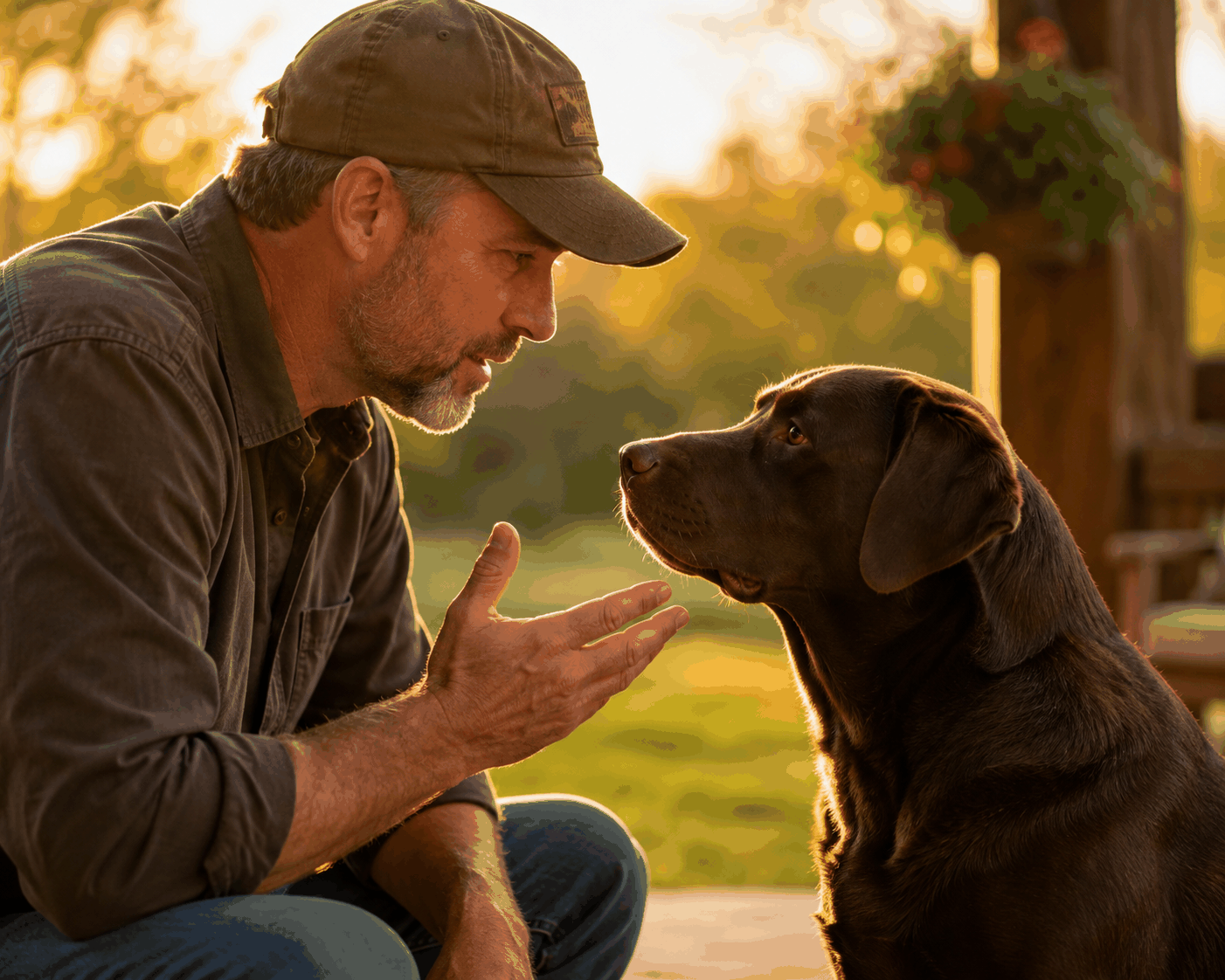
Your words are the most powerful training tool you own — the things you say, and the way you say them — and they did not cost you a dime. After thirty-five years of talking to Labradors and to the people who love them, the words we speak carry more weight than most people have any idea of — over a puppy, over a child, over a marriage, over our own selves, and maybe over more than we can see. This one is part training, part faith, and part a question I cannot put down.
Talking to your puppy: your dog hears more than you think
For years people assumed a dog only hears your tone — that you could say "you're a rotten, no-good dog" in a sweet voice and the dog would wag right along, because it is all just happy music to him. That turns out to be only half true, and the other half will change how you talk to your dog.
Researchers in Hungary put dogs in an MRI scanner and watched their brains while people spoke to them. What they found is astonishing: a dog processes both the word and the tone — and in two different halves of the brain, just like we do. The dog's brain sorts out the meaning of a familiar word on one side and the emotional tone on the other, and here is the kicker — the reward center, the pleasure center, lit up the brightest only when a praise word was spoken in a praising voice. [1] In other words, "good boy" said like you mean it lands twice as hard as either one alone. The word and the warmth together are what reach him. And there is more: dogs genuinely respond to that higher, warmer, sing-song voice we naturally use with puppies — "who's a good boy?!" — they attend to it, they come closer, and they bond to it.[2] That baby-talk you feel silly doing? Do it. Your puppy is built to listen to it.
So, starting today — talk to your puppy, a lot. Name things. Praise him big and warm when he gets it right, in a voice that carries the joy. Keep your commands calm and clear. And hear me on this one, because it is the most important — never, ever train in anger. When you correct a dog with a hard, hot, ugly voice, you are not just failing to teach him the lesson; you are teaching him to fear the sound of you. Your tone reaches him faster than your words ever will, so let the tone carry calm and confidence, not temper. You can pour steadiness right into a dog through your voice, or you can pour anxiety into him the same way. Choose what you pour.
And if you feel that frustration climbing up into your voice, stop. End the session right there, put the dog up, and come back once you have cooled off — there is no lesson worth teaching in a hot voice. The grace in it, though: a dog has a great capacity to forgive, far more than we deserve. They rebound, every one of them — some quick, some slow, at different speeds, same as people do. Some fellow, somewhere, accidentally locked his dog and his wife in the walk-in pantry, then wandered off to the den to watch the game. A while later he heard a racket, went back to the kitchen, tracked down the noise, and opened the pantry door — and only one of the two came out happy to see him. You can guess which one. That is a dog for you: quick to forgive, glad to see you, ready to start fresh. Just do not make them forgive more than they ought to have to.
How I do it in my own kennel
This is not just preaching — I live it from the very first day. My puppies get talked to the moment they are born, and every single day after that. Long before a pup can understand a word of it, my voice is filling his world, so that the sound of a calm, kind human is one of the first things he ever learns to trust. A whistle calls them to dinner, so a certain sound comes to mean good things are coming and that paying attention pays off. The verbal commands start early — sit, come — spoken gently and paired with warmth, so the words are old friends long before any formal training begins. And here is the part that matters most to me: I make my speech over them praise, gratitude, and blessing. I tell them they are good. I thank them. I speak good things over their lives out loud. Call me sentimental if you want to, but thirty-five years of raising Labradors has taught me this in my bones — a puppy brought up inside a steady stream of kind, grateful, blessing words comes up confident, settled, and bonded in a way you can feel with your hand. Those first weeks you are not only feeding a body. You are speaking a character into being.
The power of words over people
The same law that governs a puppy governs a person — only more so. The words spoken over a child become the walls that child lives inside. Tell a boy he is worthless often enough and you build him a cage; tell him he is capable and loved and you hand him a key. It works on grown people too — on a wife, a husband, a friend, a coworker — and it works on the hardest audience you will ever speak to, which is yourself. The running commentary you keep up in your own head, the words you say about your own self when you fail, are drops of water on a stone, and over enough years they carve the shape you believe you are.
None of that is soft sentiment. It is the plainest kind of true, and every one of us has both felt a cruel word land like a fist and felt a kind one lift a weight we did not know we were carrying. Words are not just noise. They are force. They build, and they tear down, and they do it a little at a time until the building is finished.
What a wise friend taught me: "it's all in the word"
I had a dear friend named Kemper — a man of real stature, nominated for the Nobel Peace Prize by the King of Nepal, Mother Teresa, and Margaret Thatcher. That is the caliber of people who put his name forward. The year Kemper was nominated, Jimmy Carter won the prize, and Yasser Arafat was among the nominees that year too. Kemper said with a laugh, "Well, I'd rather lose to a Democrat than a terrorist — though these days it's hard sometimes to tell the difference." That was Kemper. And he pressed something into me over the years that I have never gotten over. He would say it plain and slow: "John, it's all in the word."
And then he would walk me right through it. God spoke creation into being: "Let there be light."[3] Jesus' words wrestled the storm into submission — "Peace, be still" — and the wind and the waves lay right down.[3] He spoke against a barren fig tree, and when they passed by it the next day it had withered from the roots.[3] The blessings spoken over people in Scripture launched them clean into their destinies. And then there is Peter — Simon, the very man who would one day deny he even knew Jesus, not once but three times — and yet Jesus looked at that flawed, unfinished man and spoke his future over him anyway: "You are Peter, and on this rock I will build my church."[3] The word came first, and the man grew up into it.
Kemper's point became my own, and here it is: all of creation was built to respond to words. That includes your dog. It includes your family. Your husband or your wife. The homeless man you pass on the corner. The cashier ringing up your groceries. The waitress refilling your coffee. Every one of them is a soul built to respond to what gets spoken over it. You are handing out words all day long, to dogs and people both, whether you mean to or not — so hand out the kind that build, that bless, that launch a person a little further toward who they were made to be. That is a real power, and you carry it into every single room you walk into. Most folks never once think to use it on purpose.
What Scripture says about the tongue
The Bible is not quiet on the power of words — it is thunderous about it. The book of James calls the tongue a small thing that boasts great things, and says, "consider what a great forest is set on fire by a small spark." [3] He compares it to the little rudder that steers a whole ship, and to a fire, and then he lays down the sharpest line of all: out of the same mouth come blessing and cursing — "my brothers and sisters, this should not be."[3] A small thing, the tongue, that steers the whole course of a life and can burn a whole world down — there is a whole other blog on how the smallest overlooked things turn history, and here is the smallest one of all, sitting in your own mouth.
And go back further, all the way to the first page. How did God make the world? He spoke it. "Let there be light."[3] The very act of creation was a word said out loud. We are made in the image of the One who spoke worlds into being, and I do not think it is an accident that our words, too, have the power to make and unmake the little worlds around us. Proverbs says it in ten words that ought to be carved over every door: "Death and life are in the power of the tongue."[3] Believe that, and you will never again think of what you say as a small thing.
The far edge: words, water, and the experiments people can't forget
A Japanese researcher named Masaru Emoto spent years claiming that water itself responds to words. He said water exposed to kind words and beautiful music — words like "love and gratitude," which he called the two most powerful words of all — froze into gorgeous, ordered crystals, while water exposed to hatred and cruelty froze into ugly, broken ones.[4] You have probably also seen the experiments schoolteachers do to make the point: the rice-in-jars demonstration, where cooked rice is sealed in jars and one is told "I love you" every day, one is told "I hate you," and one is ignored — and folks report the loved jar ferments sweet while the hated and ignored ones rot black. And the apple experiment done in classrooms, where children speak love to one apple and hate to another for a few weeks, and the bullied apple browns and rots faster.[4]
These spread through a thousand classrooms and will not die, and the reason is not hard to see: because they put a picture to something people already know in their bones, something Scripture taught three thousand years ago — that words carry a power we do not fully understand, and that kindness and cruelty are never weightless.[4]
So speak life
None of this depends on whether an apple browns faster in a jar. You do not need a laboratory, because you have watched it with your own eyes: you have seen a gentle word settle a frightened dog, and you have seen a harsh one make him flinch. You have seen a word of encouragement straighten a child's back and a word of contempt fold it. The power is real whether or not anybody can photograph it.
So speak life. Over your puppy, over your kids, over your husband or your wife, over the tired face in the mirror. If Emoto got even the spirit of it right, then the two most powerful words you own are love and gratitude — and it costs you nothing to spend them freely, starting right now, today. A dog trained on a kind voice, a child raised on encouragement, a home built on grateful words — that is not soft. That is the strongest foundation there is.
Talk to your puppy all day long, name everything, and praise him warm and often — his brain is literally built to reward the kind word said in the kind voice. And carry the same habit out of the kennel and into the house. The tongue steers the ship. Steer it toward life.
Keep reading: The Music I Play for My Dogs: 432 Hz & Calming Sound · Why We Read the Dog, Not the Calendar (Temperament) · E-Collar Training: A Tool, Not a Punishment · Service Dogs and the Will to Live
A note from John: I am not a veterinarian or a scientist. The findings on how dogs process words and tone are footnoted below to published research, and the Scripture is quoted as my own faith. Read the sources, do your own homework, and either way — speak kindly to your dog and to the people you love. That one costs nothing and never fails.
Sources
[1] Andics, A., et al. (2016), "Neural mechanisms for lexical processing in dogs," Science. Using fMRI, dogs were found to process the meaning of familiar words (lateralized to the left hemisphere) and intonation (right hemisphere) separately, with the brain's reward region responding most strongly to praise words spoken in a praising intonation — i.e., both what is said and how it is said matter. science.org
[2] Benjamin, A., & Slocombe, K. (2018), "'Who's a good boy?!' Dogs prefer naturalistic dog-directed speech," Animal Cognition — dogs attend and respond more to the higher-pitched, affectionate "dog-directed speech" register, supporting its role in attention and bonding. link.springer.com
[3] Scripture: James 3:3–10 (the tongue as a small spark, a rudder, a fire; blessing and cursing from one mouth); Genesis 1:3 ("And God said, Let there be light"); Proverbs 18:21 ("Death and life are in the power of the tongue"); Mark 4:39 (Jesus calms the storm — "Peace, be still"); Mark 11:12–14, 20–21 (the fig tree withers after Jesus speaks against it); Matthew 16:18 (Jesus names Simon "Peter" — the rock — "on this rock I will build my church") together with Matthew 26:69–75 (Peter denies Jesus three times). Quoted as the author's faith.
[4] Emoto, M., The Hidden Messages in Water (2004), and the popular "rice experiment" and classroom "apple experiment" associated with his ideas — that kind words and music, and cruel ones, affect the structure of water and the spoilage of rice and fruit, with Emoto naming "love and gratitude" the most powerful words. Presented here as illustrations of a scriptural and cultural idea.