— HANS CHRISTIAN ANDERSEN
· · ·
“Whenever the tormenting spirit came upon Saul, David would play the harp. Then Saul would feel better, and the tormenting spirit would go away.”
— 1 SAMUEL 16:23
The Power of Music
Back in 2017, a litter was going through crate training, and one pup in particular barked constantly — the kind of relentless, all-night barking that wears out a whole household and every other puppy in the room. Those old stories about what music can do came to mind, so classical music went on when the pups were put in their crates at night.
Thirty-five years of training dogs, and here is what happened, plain as day, because it stopped me cold: that was the first time ever, across all those years, that an entire litter went through crate training and not one puppy had a single accident in its kennel. Not one. The barking settled, the whole litter slept, and they held clean through the night — a thing never once seen across a whole litter before. Music has run at crate time ever since. Calm dogs sleep, and dogs that sleep hold their kennel.
More than a dog thing
That night pointed to a bigger question, because this is not only a dog thing — it is a living thing. Two stories make the case.
A man played classical music out over his vineyard, day and night, to his grapevines, and his yield jumped a full twenty percent. Vineyards do this in earnest — a Tuscan estate called Il Paradiso di Frassina pipes Mozart out over its vines, and the South African estate DeMorgenzon plays Baroque music around its vineyard around the clock, both because it helps the vines ripen fuller and better.[1] Grown men who make their living off those grapes spend real money on speakers out in the field. That tells you something.
And a man who owned an outdoor shopping mall that was getting vandalized piped classical music through the place, and the vandalism fell off. Convenience stores, train stations, and shopping centers all over the world play classical music in their parking lots and on their platforms, and it cuts loitering, vandalism, and crime. The London Underground put classical music into its most troubled stations and robberies and vandalism dropped; 7-Eleven has piped it into parking lots for the same reason for years.[2]
So the question keeps coming back around: what is the power in music? Somewhere in there sits a truth — that ordered, gentle sound settles a living thing, whether that thing is a grapevine, a jittery crowd, or a barking dog.
The science that backs it up
None of this is just old stories and a hunch. Researchers have put real dogs in real kennels, wired them up, measured their stress, and watched what music does — and the results back up exactly what plays out in a kennel. In shelters and veterinary hospitals, classical music lowers dogs' stress: they bark less, they rest and sleep more, they settle down and their bodies show it.[3] One study out of Scotland played classical music in a rehoming center and the dogs went quiet and lay down.[3]
Then the researchers asked a sharper question: is it classical specifically, or just calm sound? A team with the Scottish SPCA and the University of Glasgow ran several genres past kenneled dogs and measured heart rate and stress hormones. Soft rock and reggae came out on top for lowering stress — but the biggest lesson was that variety matters: the same playlist on a loop gets tuned out, so mixing it up keeps the effect.[4] A dog is no music critic. It is that slow, steady, gentle sound settles a nervous system.
A whole field — bioacoustics — has pinned down what about a piece of music does the settling: a slow tempo, a simple arrangement (a single piano beats a busy orchestra), and lower, softer tones at a low volume.[5] The flip side is just as real — fast, loud, jangly music winds a dog right up.[5] Here is the mechanism in one breath: music is vibration, your dog is a body that vibration moves through, and slow gentle vibration slows the heart and quiets the nerves. Measurable, repeatable, and reason enough to put the right music on at bedtime.
The dark side: music can wound as surely as it heals
Now the other edge of the blade, because a thing powerful enough to heal is always powerful enough to harm.
Our own military knows it cold. One of the documented methods for breaking prisoners down in interrogation is pumping loud, harsh, heavy-metal music at them around the clock — hours and days on end, no sleep, no quiet, no relief. It is recognized as a form of psychological torture, and it works, because relentless, jarring sound can take a human being apart from the inside.[6] Same force as the harp and the bedtime playlist — just turned the other way and cranked into a weapon.
Cultures far older than ours have said the same thing. Tribal peoples in Africa and elsewhere have long held that certain drumbeats and certain music do more than stir the body — that some rhythms open a door to the spiritual realm and can invite dark, tormenting spirits in. It should not surprise a person of faith one bit, because Scripture says the very same thing. When King Saul was tormented by an evil spirit at night, what drove it back? Not medicine, not a sword — a boy with a harp. David played, and the tormenting spirit left him.[7] The Bible ties music directly to the spiritual realm, and shows one kind of sound driving a torment out. If good music can push darkness out, it is no stretch that the wrong kind can invite it in.
Think, too, about church bells. For centuries those bells were not clocks or dinner gongs — they were rung to drive off evil, to break up storms, to push back plague and darkness. The old bells were cast with the belief written right into their bronze, that their ringing shattered the lightning and scattered what was dark.[8] And here is what is hard not to notice: right around the 1940s the bells began to fall silent — tens of thousands of them pulled down and melted across those war years — and today you can drive clean across whole cities and never hear a single one. Take from that what you will. Just notice it.
Most people treat music like wallpaper. It is not wallpaper. It is a force, and forces cut both ways.
Now my own practice: 432 hertz
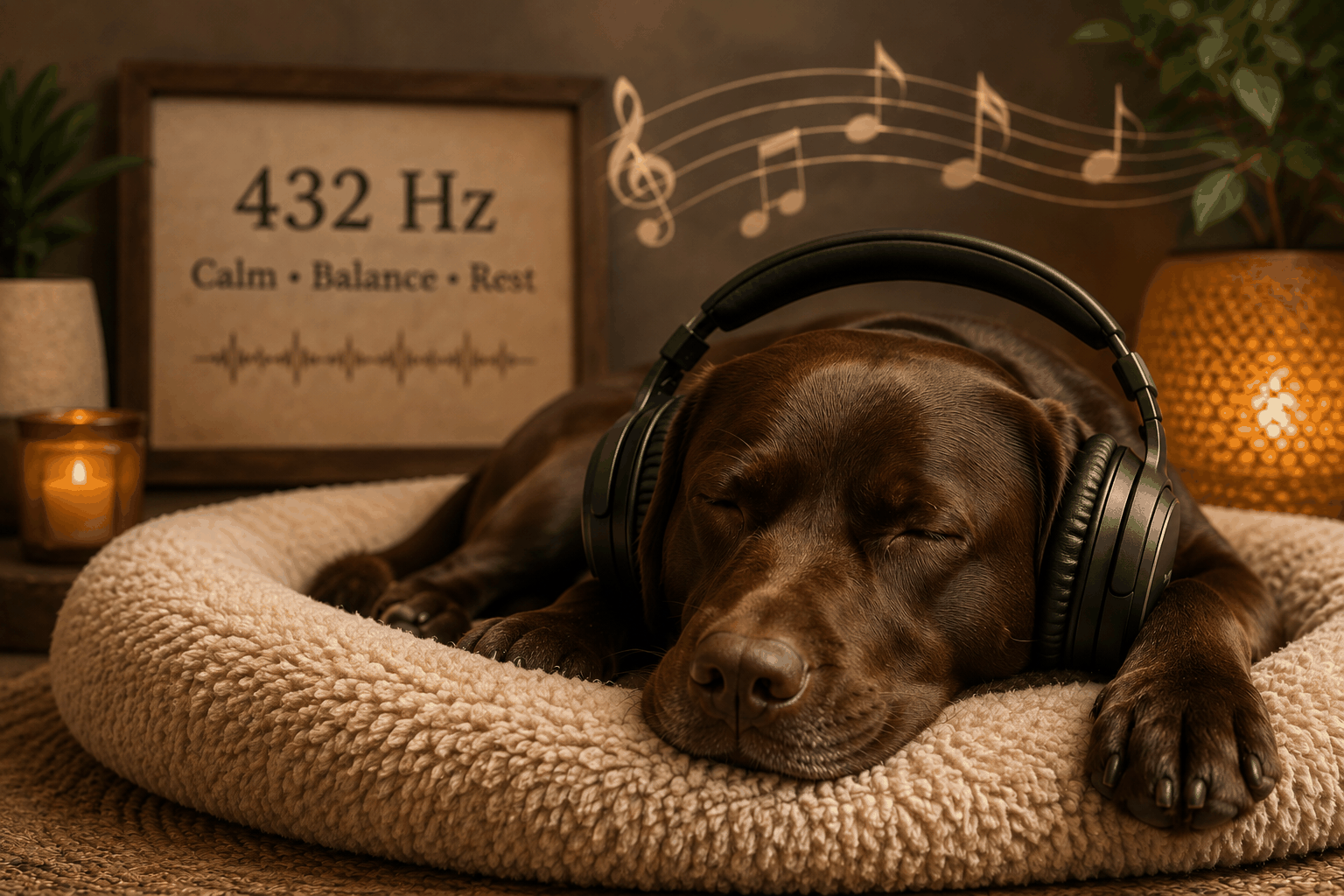
Here is the music that goes on in this kennel: tracks tuned to 432 hertz.
Almost all modern music is tuned to a standard pitch — the note "A" set at 440 hertz. But there is an older, slightly lower tuning, 432 hertz, just a hair down from it, that sits easier on the ear and the body — warmer, less tense, more restful. Put those 432-hertz tracks on at night and the dogs settle, and so does the man who set them going — long enough now to trust what shows up plain in the kennel, night after night.
Where 440 came from — and why it's worth chasing
We have been handed, the whole world over, a steady diet of music tuned to 440 hertz. It is very nearly everything you hear, everywhere you go. So the obvious question — who decided that, and when?
The 440 standard was set in 1936, in the thick of the Nazi era, promoted by Germany's own propaganda machine under Josef Goebbels — Hitler's minister of propaganda, a post he had held since 1933. The one man whose entire life's work was bending the minds of the masses put his weight behind the very tuning the whole world now hears from the cradle on.[9] And do not tell me that could not reach America — in 1936, plenty of powerful people over here were still shaking Hitler's hand: businessmen doing a brisk trade with his regime, a pro-Nazi movement filling halls on our own soil, and a nation that sent its athletes to march in his Olympics — and Time magazine would go on to name Hitler its Man of the Year for 1938.[9] The world was wide open to what came out of Germany then, and the tuning traveled right along with everything else. A regime that understood the power of sound and spectacle better than anyone before it reached for the frequency — and here we all still are, humming along to it. Dig into the history yourself; better that than taking anyone's word for it.
The older, lower tuning has a very different name attached to it. Not a propaganda minister, but Giuseppe Verdi, one of the greatest composers who ever lived, who fought so hard for the lower pitch that A=432 is still called "Verdi tuning" to this day.[9] One frequency carries the fingerprints of a propaganda ministry; the other carries the endorsement of one of the finest musical ears in history. That is the choice, laid out plain — and it is not a hard one.
The sacred-geometry side
There is one more reason 432 pulls at a person: the numbers behind it come out clean and orderly in a way 440 does not. Tune to it and middle "C" lands right on 256 hertz, a perfect doubling — two times two times two all the way up — and that same number, 432, turns up again and again in old sacred architecture and in the measures of the natural world. Folks call it sacred geometry: the idea that certain numbers and proportions are woven right into creation. The Creator built this world on order and proportion, so a tuning that lines up clean instead of messy sits right, deep down. That conviction is a big part of why 432 is the frequency filling this home and this kennel.[10]
What the research says on 432
The head-to-head research comparing 432 to 440 is still young. A double-blind study found people listening to 432-hertz music had a slightly lower heart rate than on 440 — a real result, with more work still to come.[11] Take 432 not as a proven cure but as one man's practice: more restful to the ear, settling to the dogs, lined up with how the world looks from here, and harmless either way. Try it and be your own judge.
The idea that keeps the curiosity going: words, water, and vibration
One step further out, to the part that fascinates. A Japanese researcher named Masaru Emoto spent years claiming that water, when exposed to different music and different words, froze into different crystal shapes — beautiful, ordered crystals for gentle music and kind words like "love and gratitude," and ugly, broken ones for harsh music and hateful words.[12]
It is worth raising for the question underneath it, the one that will not shake loose: your dog is roughly two-thirds water, and so are you, and sound is a vibration traveling through that water. What does a lifetime of vibration do to a body that is mostly water? The plain, provable truth sitting right next to Emoto's claim is this — gentle sound measurably slows a living body down, and harsh sound winds it up. You can measure that in a dog's heartbeat. (That thread runs further, on words instead of music, in the power-of-words piece.)
Putting it to work tonight
The practical could not be simpler:
- Play it low. Soft background volume, not a concert. Under the room, not filling it.
- Keep it slow and simple. Slow-tempo, simple instrumental — solo piano, soft strings, gentle 432-hertz sleep tracks. Skip anything fast, loud, or busy.
- Use it at the right times. Bedtime to settle them for sleep, at crate training, during thunderstorms and fireworks, and when you leave the house and a dog frets being alone. (It pairs right up with the storm-and-fireworks anxiety piece.)
- Mix it up. Do not loop the exact same thirty minutes every night — rotate it, or the dogs quit hearing it.
- Give it a couple weeks. Let it become part of the bedtime routine, until the music itself is the signal that says the day is done, you are safe, go to sleep.
Put the right music on low tonight, watch your dog let out that big sigh and melt into the floor, and feel your own breath slow down right alongside — no further explanation needed.
A cheap speaker, a slow 432-hertz or soft-classical sleep playlist turned down low, and a consistent bedtime is the whole rig. No pill, no gadget, no cost to speak of. Run it at crate training, too. If your dog is fighting real, chronic anxiety, music is a helper alongside the rest of the plan — not a replacement for getting to the bottom of it.
Keep reading: The Power of Words: Talking to Your Puppy, and to People · Storm & Fireworks Anxiety · Service Dogs and the Will to Live · Red Light & Methylene Blue
A note from John: I am not a veterinarian. The findings on calming music and canine stress are footnoted below to published research; the 432-hertz tuning, the history laid out here, and the spiritual observations are my own conviction and study. Read the sources, do your own homework, dig into the history yourself — and put on some quiet music for your dog tonight. That part can't hurt, and it just might change your kennel the way it changed mine.
Sources
[1] On vineyards playing music to vines: Il Paradiso di Frassina (Tuscany, Italy) plays Mozart to its vines and reports improved growth and ripening; DeMorgenzon Estate (Stellenbosch, South Africa) plays Baroque music continuously throughout its vineyards. The practice is used by working estates; specific yield claims (e.g., 20%) are anecdotal. classicfm.com; alparadisodifrassina.it; demorgenzon.com
[2] On classical music reducing loitering, vandalism, and crime in public spaces: the London Underground began piping classical music into troubled stations (from about 2003) and reported reductions in robberies, assaults, and vandalism; 7-Eleven and numerous retailers and transit systems use it in parking lots and on platforms to deter loitering and antisocial behavior. thehustle.co; wqxr.org
[3] Wells, D. L., Graham, L., & Hepper, P. G. (2002), "The influence of auditory stimulation on the behaviour of dogs housed in a rescue shelter," Animal Welfare; and University of Glasgow / SPCA rehoming-center work — classical music reduced barking and stress and increased resting/sleeping behavior in kenneled dogs. gla.ac.uk
[4] Bowman, A., et al. (2017), Scottish SPCA & University of Glasgow, "The effect of different genres of music on the stress levels of kennelled dogs," Physiology & Behavior — soft rock and reggae produced the greatest reductions in stress and heart rate; dogs habituated to a single genre, so variety was more effective than one style on repeat. sciencedirect.com; gla.ac.uk
[5] Kogan, L. R., et al. (2012), "Behavioral effects of auditory stimulation on kenneled dogs," Journal of Veterinary Behavior; and the psychoacoustic/bioacoustic work behind Through a Dog's Ear (Joshua Leeds, Lisa Spector, and Susan Wagner) — slower tempos, simpler solo-instrument arrangements, and lower tones at low volume calm dogs, while fast, loud, complex music increases agitation. petmd.com; akc.org
[6] On music as an instrument of psychological torture: loud, repetitive, or harsh music (often heavy metal) played at high volume for prolonged periods has been documented as an interrogation and detention technique (e.g., at U.S. facilities including Guantánamo Bay) and condemned by human-rights organizations as a form of torture. See "Music torture in the war on terror" and related reporting. en.wikipedia.org
[7] Scripture: 1 Samuel 16:14–23 — a tormenting spirit troubled King Saul, and when David played the harp, Saul was refreshed and the tormenting spirit departed. The association some cultures make between certain music and the spiritual realm is presented as belief and testimony.
[8] On church bells: bells have a long-documented tradition of being rung to ward off evil, storms, and plague, and many medieval bells were cast with inscriptions to that effect (e.g., "fulgura frango" — "I break the lightning"). During World War II (the 1940s), tens of thousands of church bells across Europe were confiscated and melted down for war metal. The meaning drawn from the timing is the author's own.
[9] On A=440: proponents trace the push for the 440 Hz standard to Nazi Germany in the mid-1930s (commonly cited as 1936), promoted under Reich Propaganda Minister Josef Goebbels, who held that office from 1933. Giuseppe Verdi had earlier championed a lower pitch (A≈432, "Verdi tuning") in 19th-century Italy. On American sympathy toward Nazi Germany in the mid-1930s: the German-American Bund held large pro-Nazi rallies in the U.S.; a number of American industrialists and public figures maintained business and social ties with the regime (e.g., Henry Ford, later awarded the Grand Cross of the German Eagle in 1938); and the United States participated in the 1936 Berlin Olympics. Time magazine named Adolf Hitler its "Man of the Year" for 1938 (issue dated January 2, 1939). Readers are encouraged to research the history for themselves.
[10] On "sacred geometry" and 432 Hz: A=432 yields middle C=256 Hz (2⁸), a clean power of two, and proponents cite recurrences of the number 432 in ancient measures and cosmology. Presented here as the author's belief and conviction.
[11] Calamassi, D., & Pomponi, G. P. (2019), "Music Tuned to 440 Hz Versus 432 Hz and the Health Effects: A Double-blind Cross-over Pilot Study," EXPLORE (NY) — a small study finding modestly lower heart rate/blood pressure and greater relaxation with 432 Hz; a preliminary result inviting further research. pubmed.ncbi.nlm.nih.gov
[12] Emoto, M., The Hidden Messages in Water (2004). Emoto reported that music, words, and intentions altered the crystalline structure of frozen water. Presented here as an idea of interest that raises a question worth pondering, not as a settled finding.