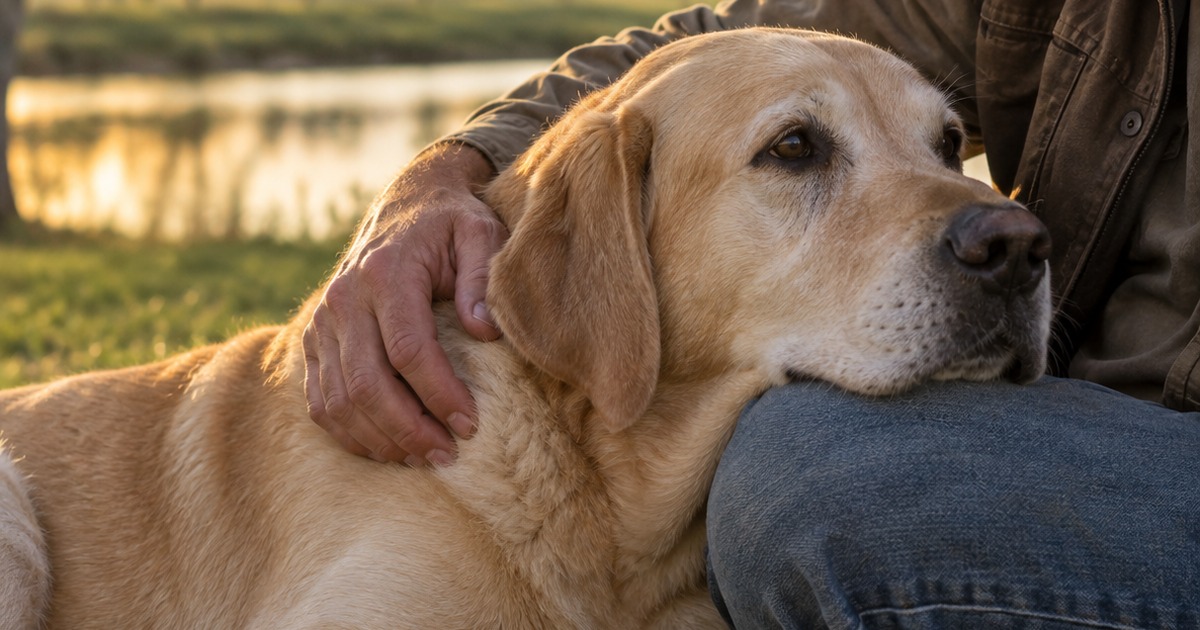
Millions of people knew Tucker Budzyn without ever scratching his ears. They knew the Golden Retriever’s broad face, comic timing, swimming, food opinions, and the voice his family gave him online. Then, within a few weeks, the story changed. Tucker’s family announced that he had lymphoma. On September 5, 2026, Courtney Budzyn told his followers that Tucker had died three days earlier, at eight years old, after an abrupt complication involving intestinal lymphoma and infection.1
“’Tis better to have loved and lost / Than never to have loved at all.”
— Alfred, Lord Tennyson, In Memoriam A.H.H., Canto 27 (1850)
There is no joke in that opening. A family lost its dog, and millions of strangers felt the empty place he left. The useful response is neither internet diagnosis nor Monday-morning medicine. It is to learn what canine lymphoma is, recognize changes worthy of attention, and understand why a dog who appears better today may still be seriously ill.
Thirty-five years around Labradors teaches a man to respect patterns: who cleans his bowl, who meets the gate, who carries his tail level, who breathes easily after work, who asks for the bumper one more time. Medicine belongs to the veterinarian. Knowing the dog in front of you belongs to the owner.
Unexplained lumps, repeated vomiting or diarrhea, loss of appetite, weight loss, marked lethargy, breathing difficulty, abdominal swelling, collapse, or any rapid change deserves veterinary attention. This article cannot diagnose lymphoma, and a normal-looking day cannot rule it out. If your dog is distressed or deteriorating rapidly, contact an emergency veterinary hospital.
What Canine Lymphoma Is
Lymphoma is not one single tumor in one predictable place. It is a group of cancers arising from lymphocytes, white blood cells that serve the immune system. Because lymphatic tissue is distributed throughout the body, lymphoma can appear in lymph nodes, the gastrointestinal tract, skin, chest, spleen, liver, bone marrow, and other sites.
The form many owners have heard about is multicentric lymphoma, often noticed as firm, usually painless enlargement of lymph nodes beneath the jaw, in front of the shoulders, behind the knees, or elsewhere. Gastrointestinal lymphoma can present differently, with vomiting, diarrhea, appetite loss, weight loss, abdominal discomfort, or subtler changes. Tucker’s family reported intestinal involvement, a detail that matters because “check for lumps” is useful advice, yet it is not the whole map.
The Difference Between Watching and Waiting
Responsible watching produces information. Waiting merely spends time.
- Write down the first day of the change. “Recently” is fog; “he skipped breakfast Tuesday and vomited Thursday” is usable.
- Track appetite, water, stool, vomiting, weight, sleep, breathing, and willingness to work. One observation may be ordinary. A pattern is evidence.
- Photograph visible swelling. Place a ruler beside it without pressing or repeatedly handling the area.
- Bring medication and supplement lists. Include doses and the time last given.
- Ask what would justify an immediate return. Leave the appointment knowing the red flags.
Do not spend three days asking strangers whether a lump “looks bad.” A photograph cannot tell you which cells are inside it. Diagnosis commonly requires veterinary examination and sampling, followed by laboratory analysis; staging or additional imaging may be recommended according to the individual case.
Why “He Looked Better” Is Not a Verdict
Dogs can rally. Medication can reduce inflammation, improve appetite, or temporarily restore energy. Cancer treatment can also produce genuine remission. None of those observations means the original diagnosis vanished, the treatment is finished, or complications cannot occur.
Tucker’s family reported that treatment appeared to be working and that he was moving toward remission before an infection struck suddenly.1 That history should not be converted into a general rule about chemotherapy or a prediction for another dog. It should teach a narrower, harder lesson: improvement and vulnerability can occupy the same room.
A dog under cancer treatment needs the monitoring plan supplied by his veterinary oncology team. Fever, gastrointestinal changes, weakness, altered breathing, refusal of food, or any rapid deterioration should be reported according to that plan. The internet cannot see the bloodwork, examine the abdomen, identify an infection, or hear the veterinarian’s instructions.
Do Not Turn One Famous Dog into Every Dog
Grief sends people hunting for a reason, and the internet rewards confident explanations delivered before the facts arrive. Somebody will blame food. Somebody will blame vaccines, lawn chemicals, genetics, a toy, a shampoo, a treatment, or the phase of the moon. The certainty usually outruns the evidence by three counties.
One dog’s diagnosis cannot establish the cause of another dog’s cancer. A responsible breeder studies pedigrees, longevity, causes of death, recurring disease, and the health of related dogs. A responsible owner supplies a veterinarian with accurate history. Neither invents certainty to fill an aching silence.
Know your dog when he is well. Put your hands on him during ordinary grooming. Know the shape beneath his jaw, the feel behind his knees, the color of his gums, his working weight, his normal appetite, his ordinary breathing, and the speed with which he recovers after exercise. Familiarity does not replace a veterinarian. It tells you when to call one.
The Life Is Larger Than the Last Week
Tucker Budzyn was not lymphoma with a social-media account. He was eight years of mornings, meals, swims, noise, hair, photographs, and companionship. Cancer belongs in his story because it ended his life. It does not own the other chapters.
That distinction matters for every family facing a diagnosis. Record the medical facts carefully. Make decisions with the veterinarians who have examined the dog. Guard comfort. Take the walk when he wants the walk. Sit on the floor when he wants company. Let grief tell the truth without allowing it to erase the life that came before it.
Millions laughed because Tucker was alive. The final respect owed to him is to learn without turning his death into a rumor, a remedy, or a sales pitch.
Keep reading: Spay & Neuter: What Every Labrador Owner Should Know
A note from John: I am not a veterinarian. This article is educational and is not a diagnosis or treatment plan. A veterinarian who examines your dog must make those decisions.
Sources
[1] People, “Social Media Dog Tucker Budzyn Dies Days After Owner Announced the Golden Retriever’s Cancer Diagnosis,” September 5, 2026.
[2] People, “Viral Golden Retriever Tucker Diagnosed with Cancer,” August 31, 2026.
[3] Cornell University College of Veterinary Medicine, “Miracle Dog Goes into Fifth Remission from Lymphoma.”
[4] Alfred Tennyson, In Memoriam A.H.H. (1850), Canto 27.