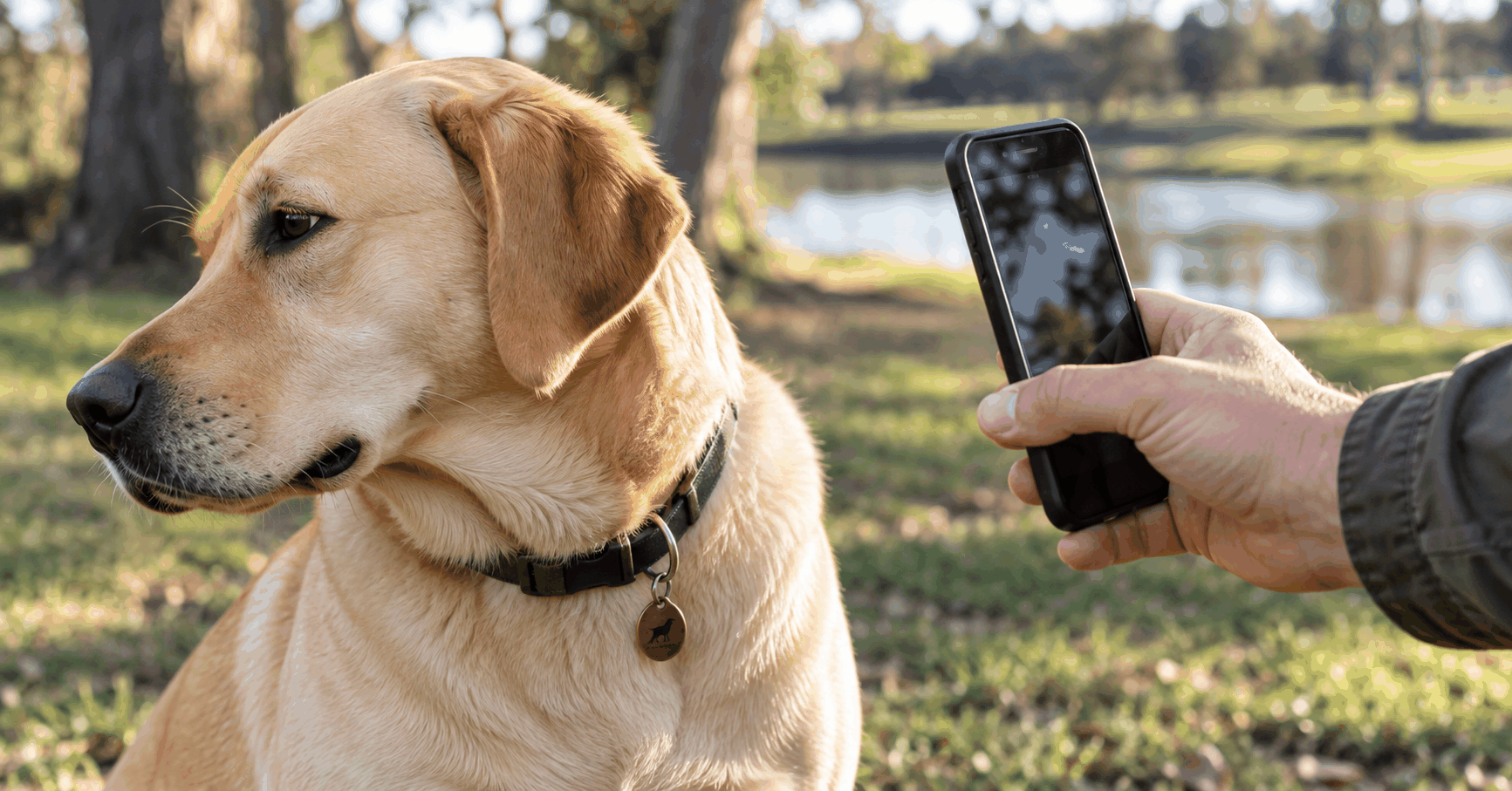
The phone comes out. The dog freezes. Somebody leans over him, wraps both arms around his neck, barks into his face, puts food just beyond his reach, dresses him like a bridesmaid, or frightens him with an object he has never seen. His eyes widen. His tongue flicks across his nose. He turns his head, yawns, pins his ears, or goes as still as a bronze lawn ornament while the people behind the camera howl with laughter.
The caption says, “He is so dramatic.” The comments say, “Do it again.” The dog has already said, as clearly as a dog can say it, Please stop.
After thirty-five years breeding and training Labrador Retrievers for field, family, therapy, and service work, one lesson has been repeated by thousands of dogs: they are honest communicators. People miss the message because they are listening for English while the dog is speaking with his eyes, mouth, ears, muscles, tail, distance, and feet. A camera does not change that language. An audience does not repeal it.
“Nevertheless the difference in mind between man and the higher animals, great as it is, certainly is one of degree and not of kind.” — Charles Darwin, The Descent of Man (1871)
“A righteous man regardeth the life of his beast: but the tender mercies of the wicked are cruel.” — Proverbs 12:10, KJV
If a video depends upon frightening, cornering, restraining, confusing, teasing, startling, or physically manipulating a dog, do not make it. If your dog turns away, freezes, retreats, repeatedly licks his lips, yawns when he is not tired, shows the whites of his eyes, lowers his body, pins his ears, or refuses a treat he normally wants, stop filming and give him room. A share is replaceable. Trust is not.
The Numbers Behind the Laugh Track
A peer-reviewed study published online in 2025 and indexed in 2026 examined 162 popular pet videos from TikTok, Instagram, and YouTube that were presented as funny. Stress reactions appeared in 82% of the videos. Researchers found a risk of injury in 52%, assumed pain in 30%, and features associated with extreme breeding traits in 32%. Nearly 94% met the study’s benchmark for successful exposure.1
Those figures are not a complaint about one foolish clip buried in a basement account with six followers and an aunt in Oklahoma. They describe successful content. The material most likely to travel was often the material in which an animal paid the bill.
A separate survey of 3,246 people found that almost every social-media user in the sample had watched animal videos, yet fewer than half often recognized suffering in them. More than nine out of ten respondents wanted warning labels on videos showing animal suffering.2 The public loves dogs. The public simply is not always fluent in dog.
A Labrador’s Smile Is Not Your Smile
Human beings are built to search for human faces and human motives. We see teeth and call it a grin. We see stillness and call it patience. We see a turned head and call it guilt. Then we add a caption, a silly voice, and music, and the dog’s actual condition disappears beneath our own story.
Read the whole dog, in context. One signal alone is a word; several signals together make the sentence.
- The quick tongue flick: A dog who has not just eaten may be asking for space or trying to settle tension.
- The unrelated yawn: A yawn in the middle of an uncomfortable encounter can be a stress signal, not a review of your entertainment.
- The turned head or averted gaze: He is trying to lower the temperature without a fight.
- The “whale eye”: When the head turns while the eye stays fixed and the white shows, the dog may be deeply uneasy.
- The freeze: Stillness is not consent. A rigid dog may be much closer to action than a noisy one.
- The retreat: If he moves away and a person follows with a phone, the person has ignored a complete sentence.
Professional animal-care guidance identifies yawning, lip licking, a tight mouth, and an averted gaze among early signs of canine stress.3 None of this means every yawn is a crisis or every glance away requires a congressional hearing. Context matters. Repetition matters. The change from that individual dog’s normal posture matters.
The Lab Who Tolerates Everything
Labradors create a special temptation because a well-bred, well-socialized Lab will forgive an astonishing amount of human foolishness. He may tolerate children climbing over him, strangers clutching his face, party hats sliding into his eyes, and the family comedian performing a surprise dental inspection for TikTok.
Tolerance is not enjoyment, and tolerance has a bank balance.
Every needless scare, every ignored retreat, every hand that drags him back into the frame makes a withdrawal. Good breeding, sound temperament, early socialization, and patient training may put a great deal into that account, yet no breeder can promise an account that never reaches zero. When the dog finally growls, snaps, or bites, the ten-second clip starts at the reaction and leaves out the fifty earlier requests that the humans ignored.
A growl is information. Punishing the warning while preserving the pressure is like pulling the batteries from a smoke alarm because the noise offended you.
Content Worth Making
Dogs and cameras are not enemies. Some of the finest dog content shows exactly why we have lived beside them for thousands of years: a retriever driving through cover, a service dog creating space for his handler, a puppy solving a puzzle, a senior dog finding the sunny square on the floor, or a young Lab learning that the strange decoy in the pond is his job and the bank belongs beneath his feet.
The difference is simple. Good content records the dog doing something willing, natural, trained, useful, or joyful. Bad content manufactures distress and calls the distress a personality.
Before posting, ask:
- Would the moment still happen if the camera were gone?
- Can the dog freely leave?
- Is his body loose, balanced, and familiar?
- Does he return willingly for another repetition?
- Am I showing a skill, a relationship, or the dog’s joy, or am I selling his confusion?
A dog retrieving the same bumper for the twentieth time may be volunteering with every cell in his body. A dog trapped in an embrace for eight seconds may be enduring every one of them. Duration does not answer the question. Choice does.
The best Labrador footage does not need a trick played upon the dog. Put a sound, willing Lab beside water, cover, a bumper, a bird, a child who knows how to behave, or a job he understands, then keep the camera steady enough to catch up. A real Labrador already brings more character to the frame than a grown adult hiding behind a shower curtain with an air horn.
Your Dog Owes the Internet Nothing
He does not owe strangers a reaction. He does not owe your followers a costume, a scare, a hug, a growl, or a second take. He owes no performance merely because the phone has a red button and the person holding it pays the feed bill.
You owe him something better: clear rules, useful work, room to retreat, protection from fools, and the courtesy of listening when he speaks softly. The dog who trusts you will cross cold water, push through briars, lie quietly beneath a restaurant table, find a child, carry a bird without crushing it, or steady a veteran when the room begins to tilt. That trust was never built by making him the punch line.
Film the beauty. Film the work. Film the muddy tail slapping the kitchen cabinet after a good morning in the field. Film the puppy falling asleep halfway out of his bed because he spent the day learning. Let the cheap laugh pass.
The dog is already giving you the better story.
A note from John: I am not a veterinarian, and this article is educational, drawn from thirty-five years of breeding and training Labrador Retrievers. A sudden change in your dog’s behavior, signs of pain, escalating fear, or aggression deserve prompt attention from your veterinarian and, when appropriate, a qualified canine-behavior professional.
Sources
[1] A. Kühnöhl et al., “Popular but Harmful—How Funny Pet Videos on Social Media Conceal Animal Suffering,” Journal of Applied Animal Welfare Science, published online 2025; PubMed record indexed 2026. PubMed abstract.
[2] A. Stumpf et al., “Societal Perception of Animal Videos on Social Media—Funny Content or Animal Suffering? A Survey,” Animals 14, no. 15 (2024): 2234. Open-access study.
[3] ASPCApro, “Canine Body Language Tips,” identifying yawning and lip licking, particularly with a tight mouth and averted gaze, as possible early stress signs. ASPCApro guidance.
[4] Humane World for Animals, “Viral Pet Trends: Are They Safe for Dogs and Cats?” June 12, 2026. Animal-safety overview.
[5] Charles Darwin, The Descent of Man, and Selection in Relation to Sex, vol. 1 (London: John Murray, 1871), Chapter III. Darwin Online primary text.