On September 3, 2026, a violent passenger aboard American Airlines Flight 618 attacked the man seated beside him, hurled slurs and vulgarities through the cabin, and turned an ordinary Dallas-to-Newark flight into a midair emergency. Passengers and crew subdued him with zip ties and duct tape. The captain diverted to Baltimore, police made an arrest, state assault and disorderly-conduct charges followed, and the FBI opened an investigation.[1]
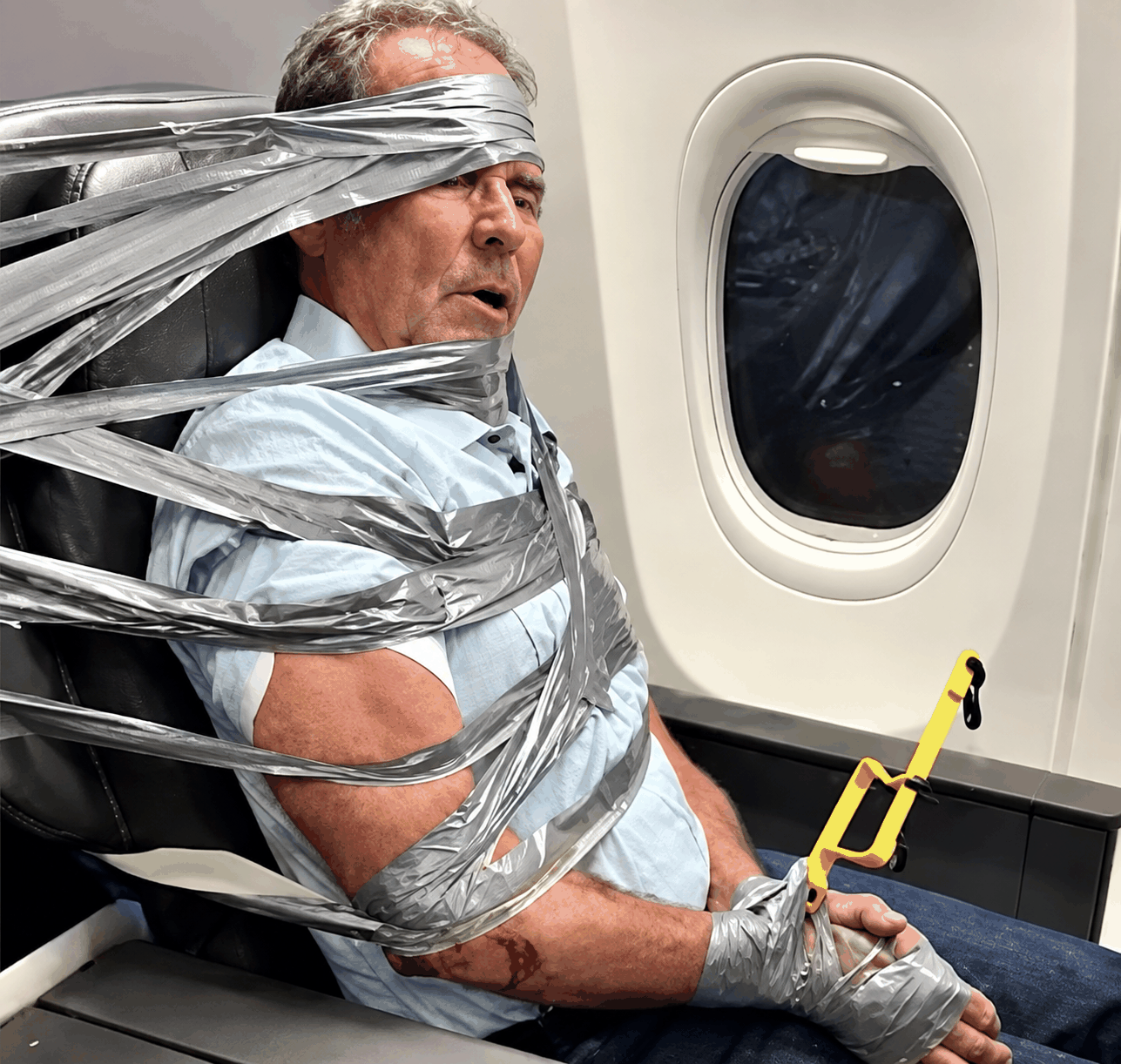
The attacked seatmate was Rabbi Jonathan Cahn—a nationally published, New York Times bestselling author of twelve books, including The Harbinger.[2][6] Cahn reported the attack to police. And when he later told the full story, one thought became impossible for this trainer of working dogs to ignore: in thirty-five years of putting service dogs on airplanes, I have never once had to duct-tape a Labrador to a seat.
Service Dogs: Better Mannered Than Most Airline Passengers
“A righteous man regardeth the life of his beast: but the tender mercies of the wicked are cruel.” — Proverbs 12:10
“Be the person your dog thinks you are.” — Old saying
A grown man, secured to his first-class seat with hardware-store supplies, in front of God and everybody, because he could not do the one thing we ask of a house cat: sit there and behave.
Then the story took another turn.
Eyewitness Juan Mejia described seeing the passenger with his hands around Cahn's neck. Other passengers and crew intervened. After the emergency landing, Cahn reported the attack to police.[1][2]
Cahn supplied the fuller account of what passed between the two men before the violence. He said they began with a friendly conversation, but the man's demeanor changed suddenly when the discussion turned to Jesus, God, and spiritual power. Cahn said the passenger began cursing Jesus, threatened to punch his “Jewish face,” struck him, and fought him over his laptop. Cahn described the sudden transformation as spiritual warfare and said he chose not to retaliate.[2]
The attack was witnessed. The restraint, diversion, arrest, state charges, and federal inquiry are matters of public record and independent reporting. Cahn's firsthand account supplies what eyewitnesses elsewhere in the cabin could not hear: the conversation immediately preceding the violence and the words directed at him.
And the fact remains: not one service dog I have flown has ever needed duct tape. Not one time.
I have flown green young dogs through long, loud, miserable trips. They faced roaring engines, crowded aisles, strange feet, food smells, nervous travelers, changing pressure, and nowhere to go. Yet the standard remained the same: settle down, stay quiet, remain under control, and do your job.
Let Us Compare the Résumés
Put the two side by side, fair and square, and let the leash tell on us.
A properly trained service dog boards the aircraft and lies at its handler's feet. The passenger in this story could not remain peacefully in his own seat.
A properly trained service dog stays quiet unless there is a genuine reason to alert. This passenger was reported shouting vulgarities and racial and homophobic slurs loudly enough that people rows away stepped in.
My dogs keep their hands to themselves—admittedly an easier standard for an animal born without hands. But the passenger had two and still could not manage it.
My dogs have never caused a flight to divert. They have never been arrested at BWI. They have never faced an assault charge. They have never required passengers, flight attendants, police, an airline press office, and the FBI to deal with their conduct.
American Airlines stated that it does not tolerate violence. The FBI opened an investigation into what happened in the air.[3] Think about the machinery required: an aircraft diverted, a crew forced into crisis mode, travelers pressed into service, law enforcement waiting at the gate, and federal agents interviewing witnesses—all because one grown man could not remain civil for the length of a movie.
In thirty-five years, not one dog I raised has required a corporate statement or a federal file.
Set the behavioral bar wherever you like. The Labrador clears it.
Flight 618 Was Not an Isolated Case
If Flight 618 were the only example, we could call it one man's spectacular failure of manners and move along. It was not.
In May 2026, a passenger aboard a United Airlines flight from Newark to Guatemala City assaulted another traveler and tried to open an aircraft door at 36,000 feet. The flight diverted to Washington Dulles.[7]
That same month, another United flight—Chicago to Minneapolis—diverted to Madison after a passenger created a security threat and had to be restrained. The aircraft carried 147 passengers and six crew members. Everybody's trip changed because one person could not remain under control.[8]
In 2023, a passenger on a United flight from Los Angeles to Boston tried to open an emergency-exit door and then attacked a flight attendant with a broken metal spoon. Other passengers tackled him, and he was later sentenced to prison.[9]
Then there was the 2024 American Airlines passenger flying from Milwaukee to Dallas who announced that he was the captain, demanded to leave the aircraft while it was in flight, attacked a 79-year-old flight attendant, and tried to open a cabin door. Passengers restrained him with duct tape.[10]
Door grabbing. Crew attacking. Biting. Threatening. Punching. Emergency diversions. Zip ties. Duct tape. Federal agents.
Meanwhile, somewhere over America, a Labrador is lying quietly beneath a seat, wondering why the species with opposable thumbs requires so much supervision.
How Many Service Dogs Fly Without Becoming a News Story?
The federal government does not publish a live national counter showing how many legitimate service dogs board aircraft each day, nor does it maintain a public database titled Dogs That Lay Down, Did Their Jobs, and Bothered Nobody. Quiet competence rarely generates paperwork.
But the Department of Transportation supplied a serious benchmark when it wrote the modern service-animal rule. Using airline and federal transportation data, DOT estimated 319,000 service-animal trips per year on U.S. carriers and on foreign-airline flights to and from the United States.[11]
That works out to approximately:
- 874 service-animal trips every day
- 6,135 every week
- 26,583 every month
- 319,000 every year
The estimate is not a current 2026 census, and the government does not publish a matching total for incident-free service-dog flights. Therefore, no honest writer can manufacture an exact “99-point-something percent” success rate.
What the record does show is scale. Hundreds of thousands of service animals travel in a year. The overwhelming majority do their work without forcing a captain to divert, without putting a flight attendant in danger, without being restrained by strangers, and without meeting police at the gate. They are so consistently uneventful that nobody takes video.
That is the difference between training and entitlement. The trained dog boards prepared to serve. The unruly passenger boards believing the entire aircraft must absorb whatever behavior he decides to unload.
The Law Expects Service Dogs to Behave
This comparison is more than a joke. Under federal air-travel rules, airlines may treat an animal as a service animal only when it is a dog individually trained to perform work or tasks for a person with a disability. Airlines may refuse transportation if the dog poses a direct threat, causes a significant disruption, or misbehaves in the cabin or at the gate.[4]
In plain English: a service dog does not receive a free pass merely because somebody calls it a service dog. It must be trained. It must remain under control. It must fit safely into the aircraft environment. Behavior counts.
That is as it should be. A legitimate service dog carries enormous responsibility. Its conduct affects its handler, the crew, nearby passengers, and every disabled traveler who will board with a working dog after it.
But perhaps the humans ought to notice something: we ask the dog to prove it can behave before we trust it in the cabin. We generally trust the human until the duct tape comes out.
The Real Heroes—and the Real Lesson
Two passengers deserve particular credit. Juan Mejia, a former law-enforcement officer, and his friend Richard Olenick saw the situation turning dangerous and intervened. Their purpose, Mejia explained, was not to hurt the man but to restrain and control him so the situation would not escalate.[5]
They did not merely hold up phones and collect content. They stood up and protected a cabin full of strangers. The flight crew also managed a dangerous, fast-moving incident and brought the aircraft safely to the ground.
That is the serious heart of this story: self-control—the possession of it, the loss of it, and the courage required when someone else's loss of control puts innocent people in danger.
This is why the story lands so hard for a dog trainer. Temperament testing, socialization, stress conditioning, obedience, and years on the training field all serve one central purpose: building reliable self-control in a creature that begins life as pure impulse.
A puppy wants to bolt, grab, bark, chase, investigate, and eat whatever hits the floor. Training teaches the dog to hold: hold the stay when it wants to run; hold its composure when the world grows loud; hold its focus when a hundred distractions pass within inches; hold its position in a screaming metal tube at thirty thousand feet.
We spend a fortune and a lifetime teaching a dog to master itself. Then members of our own species—creatures blessed with reason, language, conscience, and the ability to buy a first-class ticket—sometimes board an airplane and throw self-government in the trash.
The dog worked for its manners. What is our excuse?
Spiritual Warfare at 30,000 Feet
Cahn called the attack spiritual warfare. He described a man who changed “from light to dark” in a split second when the conversation turned to Jesus and the real power of God. Then came the cursing of Jesus, the threat against Cahn's “Jewish face,” and the physical attack.
That sequence is Cahn's firsthand testimony, and Christians will recognize the battle he is describing. The name of Jesus still exposes what polite conversation can conceal.
Cahn did not retaliate. His restraint was not weakness; it was obedience.
Scripture says:
“Do not be overcome by evil, but overcome evil with good.” — Romans 12:21
Biblical restraint does not mean allowing violence to continue. On Flight 618, goodness looked like restraint in both senses of the word: one man refusing to strike back, two passengers stepping forward to stop the danger, and a crew getting everyone safely onto the ground.
There is a plain truth sitting in that duct tape, and it is worth saying aloud:
A well-trained service dog is a better citizen of an airplane—and often of the rest of life—than a grown human who refuses to govern himself.
That may be an indictment of bad human behavior. It is certainly a high compliment to the dog.
John's Field Note
People ask me all the time for the “secret” to a dog that behaves like a gentleman in public.
There is no secret.
It is the same foundation behind a child who says “yes, ma'am,” a soldier who holds the line, and a man who keeps his mouth shut on an airplane: somebody cared enough to teach self-control before the moment of crisis, and the lesson was practiced ten thousand times when the stakes were low so it would be there when the stakes were high.
That is not a dog trick. That is character.
It is built the same way in the whelping box and the high chair. We just seem to have gotten better at it with the dogs.
Sources
[1] People, “Disruptive Passenger Restrained with Duct Tape in First Class, Forcing Flight to Make Emergency Landing,” updated September 6, 2026. The report says American Airlines Flight 618, traveling from Dallas–Fort Worth to Newark, diverted to Baltimore after a passenger allegedly shouted slurs and assaulted travelers. Eyewitness Juan Mejia described seeing the man with his hands around the neck of the seatmate beside him. Passengers and crew restrained the man with duct tape and zip ties; authorities arrested him after landing. The report also quotes the FBI as saying agents were interviewing witnesses and would consult the U.S. Attorney's Office regarding possible federal charges. Read the report.
[2] Cahn was the attacked seatmate and reported the attack to police after landing. His firsthand account describes the friendly opening conversation, its turn toward Jesus and “the real power of God,” the threat against his “Jewish face,” the fight over his laptop, his refusal to retaliate, and his understanding of the event as spiritual warfare. Eyewitness reporting independently confirms that Cahn was physically attacked. Read the report.
[3] American Airlines told People: “The safety and security of our customers and team members is our top priority and we do not tolerate violence.” The same report quotes the FBI as saying it was conducting interviews, gathering facts, and consulting the U.S. Attorney's Office for the District of Maryland about whether federal charges would be filed. Source.
[4] U.S. Department of Transportation, Airline Passengers with Disabilities Bill of Rights, Right 7. DOT states that airlines must permit a service dog to accompany a passenger with a disability unless, among other exceptions, the dog poses a direct threat, causes a significant disruption, or misbehaves in the cabin or at the airport gate. A refusal must rest on an individualized, objective assessment. Read the DOT guidance.
[5] News reports identify Juan Mejia and Richard Olenick as passengers who intervened with the crew. Mejia said their purpose was to restrain and control the man rather than hurt him so the incident would not escalate. Read the account.
[6] Cahn's twelve published books are The Harbinger; The Harbinger Companion; The Mystery of the Shemitah; The Book of Mysteries; The Paradigm; The Oracle; The Harbinger II: The Return; The Return of the Gods; The Josiah Manifesto; The Dragon's Prophecy; Avatar; and The Altar of Pergamon. Several of his titles have appeared on national bestseller lists; The Paradigm debuted at No. 5 on The New York Times Best Seller list, while The Oracle reached No. 1 on Publishers Weekly and Amazon lists and appeared in two New York Times categories.
[7] In May 2026, a United Airlines flight from Newark to Guatemala City diverted to Washington Dulles after a passenger attempted to open a cabin door at cruising altitude and assaulted another traveler. Read the report.
[8] Associated Press, May 30, 2026. United Flight 2005, carrying 147 passengers and six crew members from Chicago to Minneapolis, diverted to Madison, Wisconsin, after an unruly passenger created a security concern and was restrained. Read the AP report.
[9] Federal prosecutors said Francisco Severo Torres attempted to open an emergency-exit door and attacked a flight attendant with a broken metal spoon aboard a March 2023 United flight from Los Angeles to Boston. Passengers restrained him. He later pleaded guilty to interfering with flight-crew members using a dangerous weapon and was sentenced to 18 months in prison followed by supervised release. Read the initial Reuters report.
[10] On November 19, 2024, passengers restrained an American Airlines traveler after he claimed to be the captain, attacked a 79-year-old flight attendant, and attempted to open a cabin door during a Milwaukee-to-Dallas flight. The incident was reported to federal authorities. This example should be linked to the relevant federal charging or court record when the web editor publishes the article.
[11] In its 2020 final rule on service animals in air travel, DOT estimated that U.S. airlines transported approximately 281,000 service animals in 2017 and foreign carriers transported another 38,000 on flights to and from the United States—a combined annual estimate of approximately 319,000. The daily, weekly, and monthly figures above are simple averages calculated from that annual estimate. Read the DOT final rule and methodology.
Editorial note: The criminal charges were pending at the time of publication, and the accused is presumed innocent unless and until proven guilty. The physical attack on Cahn was witnessed by other passengers, Cahn reported it to police, the flight was diverted, police made an arrest, and state charges followed. Cahn's firsthand account supplies the precise religious conversation and the spiritual meaning he drew from it. The humor in this article concerns behavior—not anyone's health, disability, or medical condition. Written for Hunters Creek Retrievers.