— Barbara Kingsolver, The Poisonwood Bible
“The LORD is nigh unto them that are of a broken heart; and saveth such as be of a contrite spirit.”
— Psalm 34:18
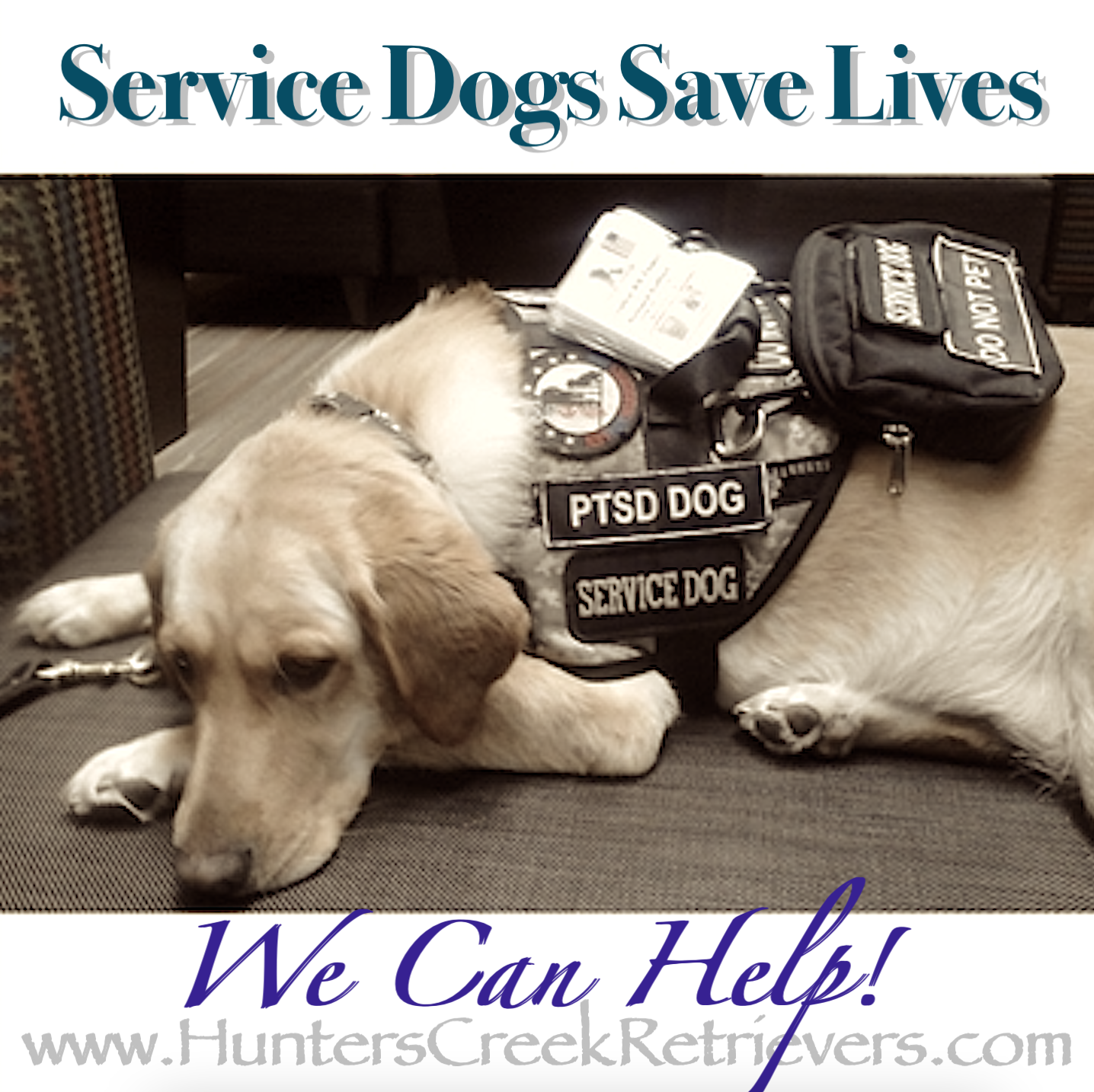
Fifty-some dogs placed with veterans carrying PTSD, anxiety, and mobility challenges have taught me this: the dog isn't a mascot for a wound. It's trained to do a job, same as any working retriever, except the bird it's fetching is a man's attention before the nightmare gets to the surface.
What the Dog Is Actually Trained to Do
“My husband served 8 years in the Marine Corps. On his first deployment he was in an IED incident where 10 died and 11 were wounded including my husband. Since this event in 2005 he has struggled with PTSD and flashbacks.”— Wife of a Marine Corps veteran
Forget the greeting-card version of a service dog. Veterans who work with a trained psychiatric service dog report using its trained tasks about three times a day on average, and the two tasks rated most important are simple to describe and hard to execute: calming or comforting the handler through active anxiety, and interrupting or alerting to rising anxiety before it becomes a full episode.1 That second one is the real skill — a dog with the right temperament trained to read the early tells of a panic spiral and put its body between the man and the moment, physically, on cue, before he's consciously aware what's happening.
Here's the part that surprised even the researchers: veterans rate the dog's untrained behavior — plain companionship, physical affection, a calm presence in the room — as more important to them than the trained tasks themselves.1 Training builds the skill. It is the sensitivity of the soul of the right dog that provides the most important impact.
Matching the Right Dog Comes First
Matching the right dog is the first and most important hurdle. Think of it as getting married: who you marry is the first major hurdle. If you answer that right, everything else still may be challenging as you learn new ways of living, but with the right partner every challenge can be conquered: public access, crowds, elevators, escalators, bathrooms, tight spaces, sporting events, grocery stores, long lines, specialty training, alerts, picking up items and more.
Matching the right dog to the right person is a talent built on years of training dogs. Even the big national programs that breed and test their own dogs lose roughly three of every ten dogs that enter formal training.2 In a study of 118 guide dog partnerships, handlers judged one in four a mismatch, and more than a third of the dogs went back before retirement, most often over the dog’s social behavior, work rate and walking pace.3
How We Build That Dog, Starting at Eight Weeks
Not every puppy is built for this work, and pretending otherwise is how good organizations put unfit dogs into rough situations and call it charity. We temperament-test early, we watch drive and recoverability under stress, and we select for a dog that is stable enough to lie still in a crowded VA waiting room and confident enough to lean its body weight into a man mid-flashback without flinching. Foundation obedience comes first. Socialization and public access work — elevators, crowds, restaurants, loud trucks backfiring two blocks over — comes next, because a dog that panics at a car alarm is worthless to a veteran whose whole nervous system panics at a car alarm.
Public Access: Everywhere the Handler Goes
A service dog works 24/7 beside its handler, wherever the handler goes. The Assistance Dogs International Public Access Test, the AKC Canine Good Citizen Urban test and the ADA rules spell out what the dog has to handle:4
- The parking lot — a controlled unload from the vehicle on command, then a steady heel past traffic, shopping carts and other dogs.
- The doorway — waiting quietly while the door opens, then entering under control without pulling or seeking attention.
- Crowds and tight spaces — heeling within touching distance through busy aisles, long checkout lines, malls, stadium concourses, rodeos and sporting events, adjusting to every turn and change of speed.
- Elevators and stairs — entering, riding and exiting under control.
- Escalators — moving steps and comb plates can trap paws, fur or a harness, so the elevator or the stairs is the standard route unless a dog has had specialist escalator training.5
- The grocery store — holding a sit while a cart rolls past, ignoring food on the floor and never sniffing merchandise. Under the ADA the dog stays on the floor, not in the cart.6
- Restaurants — settling under the table, out of the aisle, quiet through the whole meal.
- Restrooms and stalls — tucking into a tight space beside the handler and holding it.
- Noise — a dropped tray, a car alarm, a horn: the dog may startle, but it recovers fast with no fear or aggression.
- Strangers and children — holding a down while people approach, and never soliciting food or petting.
- Air travel — riding in the handler’s foot space without crowding the next passenger.7
- A dropped leash — staying with the handler and under control until the leash is back in hand.
- Relieving on command — only when and where the handler gives a command.
Then comes the specialty training, the tasks that make a service dog a service dog: alerting to an oncoming episode, interrupting anxiety, deep pressure therapy, retrieving dropped items, guiding the handler to an exit, turning on lights during a night terror.8 The International Association of Assistance Dog Partners sets a minimum of 120 hours of training over six months or more, with at least 30 of those hours spent working in public places.9
Hypervigilance Is the One We Chase Hardest
Of every PTSD symptom a trained service dog can address, hypervigilance — that exhausting, always-scanning-the-room state combat leaves behind — responds best to trained dog work, with most veterans reporting multiple specific tasks helped directly.1 Watching a dog trained for this is like watching a man's shoulders come down from around his ears for the first time in years. That's not a metaphor; you can see it in a man who can finally relax.
What Kind of Service Dogs We Train
PTSD is the work Hunters Creek has the deepest record in, but it is not the only job for these Labradors. Many handlers live with invisible disabilities. Every one of these dogs is task-trained, not simply comforting.
- PTSD & veteran service dogs — room checks for hypervigilance, waking the handler from nightmares, blocking crowds, deep pressure therapy during a flashback, alerting to panic attacks and interrupting anxiety before it peaks.
- Psychiatric service dogs — non-veteran PTSD, anxiety disorders and panic disorder, trained to the same task list.
- Mobility assistance dogs — bracing on stairs, retrieving dropped items, medication or a phone, opening doors, turning on lights.
- Diabetic alert dogs — medical alert dogs imprinted on blood sugar scent through medical alert scent training, alerting the handler to changes in blood sugar before they swing into an emergency.
- POTS & cardiac alert dogs — alerting to pre-fainting signals, an irregular heartbeat or blood pressure spikes, and bracing to prevent a fall during a fainting spell. POTS is one form of dysautonomia.
- Autism service dogs — tethered tracking to stop wandering, interrupting self-injurious behavior, grounding a child who is overstimulated, through sensory overload, sensory meltdowns and sensory processing trouble.
- Seizure response dogs — lying beside the handler, alerting someone in the home, retrieving medication.
- Therapy dogs — Animal Assisted Therapy in facilities, nursing homes, hospitals, schools and classrooms, counseling offices, and hospice work. Duke, the “King K9,” serves families fighting childhood cancer at Ronald McDonald House, and Tomball ISD approved one of our dogs to accompany a junior high student to school.
In Their Own Words
“The first week that we had our HCR dog, we went out in public, played 18 holes of golf, and took a family trip to an arcade. He did fantastic and didn’t miss a beat. He is trained to sleep beside my husband which helps with anxiety in public places and is a buffer between him and large groups of people.”— Wife of a Marine Corps veteran, on his PTSD service dog
“I cannot tell you how he single handily changed my life by pairing me up with the most incredible Labrador Retriever… I had finally found a way out of living with inner turmoil and my personal hell. It was Rugger, the dog who went everywhere with me including buying him a seat on an airplane next to me. John completely changed my life.”— David, PTSD service dog handler
“Bro is a wonderful add to our family and I’ve already seen a change in my husband… John has spent hours with us, making sure we are comfortable with Bro and have what we need to make Matt & Bros relationship a success.”— Wife of a Marine Corps veteran
“Before her, school and other public places were incredibly difficult, uncomfortable experiences that could even be near-impossible for me to deal with. Now, with Umber there to do her task work when I need her, my life is so much easier… I have much less worry about what I will do if another attack comes on- because she is there to help me.”— Maci, on Umber, service dog
“…already showing signs of natural alerts and responding to my medical episodes perfectly!! … If you are looking for a service dog look no further than Hunters Creek Retrievers!!! Mr. John is so amazing, he spoke with me as well as my parents and matched me with the absolutely perfect puppy!!!”— Jamie, on Pluto, medical alert service dog
How to Choose a Service Dog Trainer
What is the extent of the trainer’s credentials? Are they an AKC Canine Good Citizen Evaluator/Trainer? How many years have they trained dogs and people? What tools do they use for training? If they are absolutely averse to some training tools, you might keep making phone calls. I am an AKC Certified Canine Good Citizen (CGC) Trainer/Evaluator and Canine Good Citizen Urban (CGCU) Dog Trainer/Evaluator, with 35 years training dogs.
Has the trainer worked with kids, and what is the youngest child they have worked with and been successful in teaching them to control a dog that may weigh 3 or 4 times more than the child? We have trained too many kids to count who can control their dog, and the evidence is right on our website: Clifford’s master, a four-year-old, completely controlling Clifford just twelve hours after the two met.
Unless you are having the trainer move in with you, everyone in the family needs to be able to control your dog. Think of your dog trainer as a life coach, personal trainer or nutritionist. All those require some level of work on your part for success to occur. What a trainer does is offer you a road map to success, and the better the trainer, the fewer detours to the prize.
If you’re not sure what you, your family and your dog might need to be a success, take some time and complete the training application and book an IN-HOME EVALUATION to see the difference 35 years of experience translates to your success with your fur buddy!
What This Dog Is Not
A service dog is not a substitute for the VA, a therapist, or medical care a veteran might need; a dog is one more tool in the process to living life without a constant cloud overhead. Nothing beats the devotion, loyalty and unconditional love of a dog.
Sources
[1] Frontiers in Psychology, “Defining the PTSD Service Dog Intervention: Perceived Importance, Usage, and Symptom Specificity of Psychiatric Service Dogs for Military Veterans,” 2020 — frontiersin.org
[2] Bray EE et al., Proceedings of the National Academy of Sciences, 2017 (“only ~70% of dogs that enter training ultimately achieve success”) — pmc.ncbi.nlm.nih.gov; MacLean EL & Hare B, Frontiers in Veterinary Science, 2018 (76 graduated, 35 released) — frontiersin.org
[3] Lloyd J, Budge C, La Grow S, Stafford K, guide dog matching study, Frontiers in Veterinary Science, 2016 (50 handlers, 118 partnerships) — frontiersin.org
[4] Assistance Dogs International, Public Access Test — ADI PAT form; American Kennel Club, Urban CGC test items — akc.org
[5] European Guide Dog Federation, “Guide Dog Escalator Accessibility Challenges,” April 2026 — egdfed.org
[6] U.S. Department of Justice, “Frequently Asked Questions about Service Animals and the ADA” — ada.gov
[7] 14 CFR § 382.77 — law.cornell.edu
[8] Psychiatric Service Dog Partners, Work & Task List — psychdogpartners.org
[9] IAADP Minimum Training Standards for Public Access — iaadp.org